

The Battle of the Plains of Abraham, fought outside Quebec on September 13, 1759, was one of the most consequential military encounters in Canadian history. The fighting was brief, but its effects extended far beyond the battlefield. It helped bring about the British conquest of New France, altered the balance of power in North America and began the difficult process through which French and British institutions would eventually coexist within Canada. Yet the battle should not be treated as an isolated event that single-handedly created the country. It was the dramatic turning point in a much larger imperial war whose final outcome remained uncertain for another year.
The battle formed part of the Seven Years’ War, a worldwide conflict involving Europe, North America, the Caribbean, Africa and Asia. Britain and France competed for territory, trade and strategic influence, while numerous Indigenous nations pursued their own interests and defended their lands through shifting alliances. By 1759, British forces had captured Louisbourg and several important French positions, opening the St. Lawrence River to an attack on Quebec. The loss of Quebec would threaten France’s entire position in the St. Lawrence Valley.
In June 1759, a large British fleet carried Major-General James Wolfe and nearly 9,000 soldiers to Quebec. The city occupied a formidable position on the cliffs overlooking the St. Lawrence. Its defenders were commanded by Lieutenant-General Louis-Joseph, Marquis de Montcalm, who deployed French regulars, colonial troops, Canadian militia and Indigenous allies along the Beauport shore east of the city. Wolfe established positions on Île d’Orléans and Pointe-Lévy, from which British artillery bombarded Quebec. The siege continued for nearly three months and inflicted extensive damage, particularly upon the Lower Town. Nevertheless, Montcalm’s principal defensive line remained intact.
Wolfe attempted to force a decision on July 31 by attacking French positions near Montmorency. The operation failed, producing heavy British casualties without breaking the French defences. As summer drew to an end, Wolfe faced worsening health, declining supplies and the approaching autumn. His fleet could not remain indefinitely in the St. Lawrence once the weather deteriorated. He therefore adopted a hazardous plan to land west of Quebec and compel Montcalm to fight outside his prepared positions.
During the night of September 12–13, British troops moved upriver in small boats and landed at Anse-au-Foulon, a narrow cove beneath steep cliffs. An advance party climbed the wooded heights, surprised the small French guard and secured the path. By dawn, approximately 4,500 British soldiers had reached the plateau and formed across the Plains of Abraham. Wolfe had placed his army between Quebec and the French supply routes leading westward toward Montreal.
Montcalm now faced a difficult decision. He could wait for additional troops under Louis-Antoine de Bougainville, or he could attack before the British strengthened their position. Concerned that Wolfe might entrench and threaten Quebec’s communications, Montcalm hurried much of his army from Beauport and prepared an immediate assault. His force included French regulars, colonial soldiers and Canadian militia, although some troops remained elsewhere around Quebec.
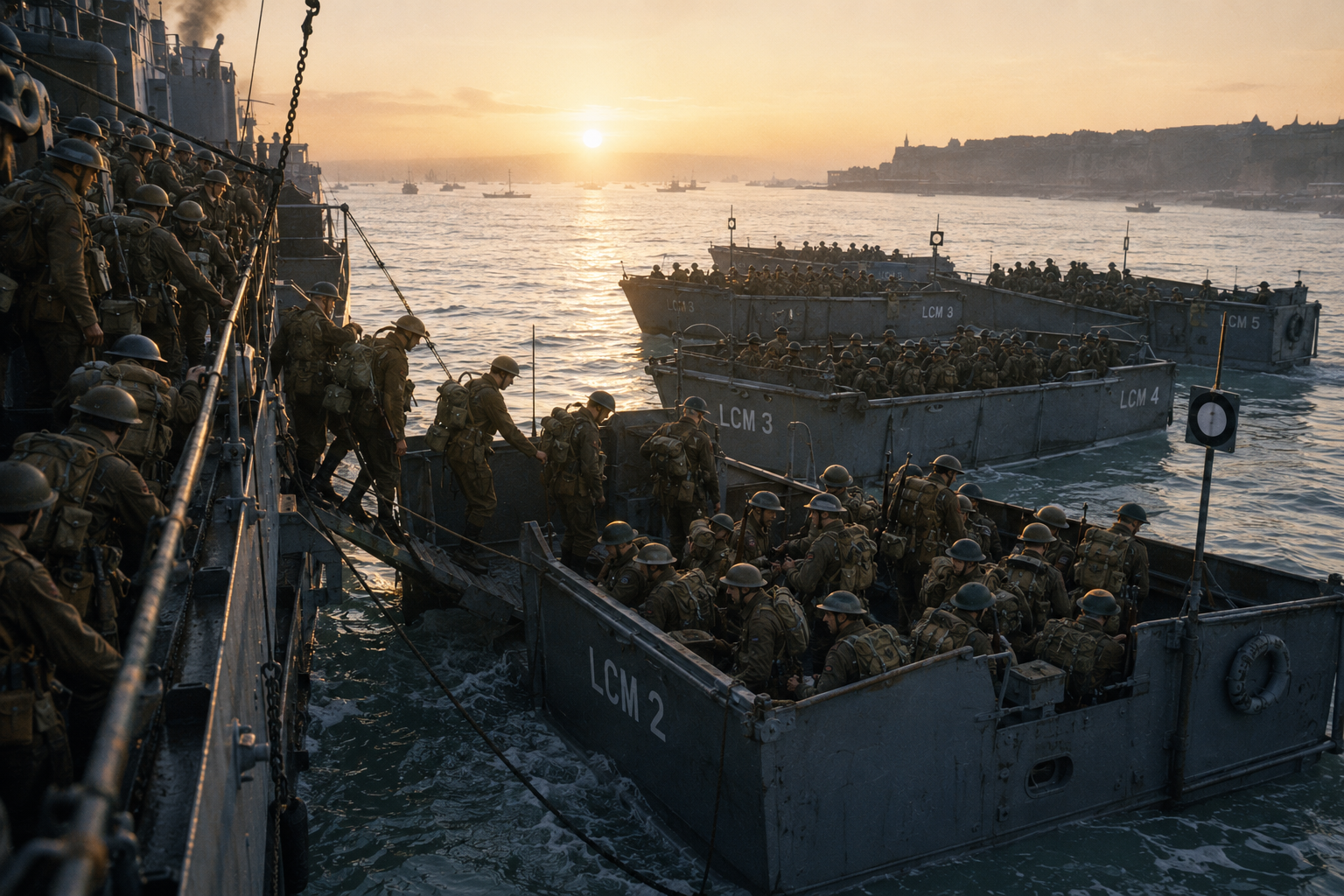
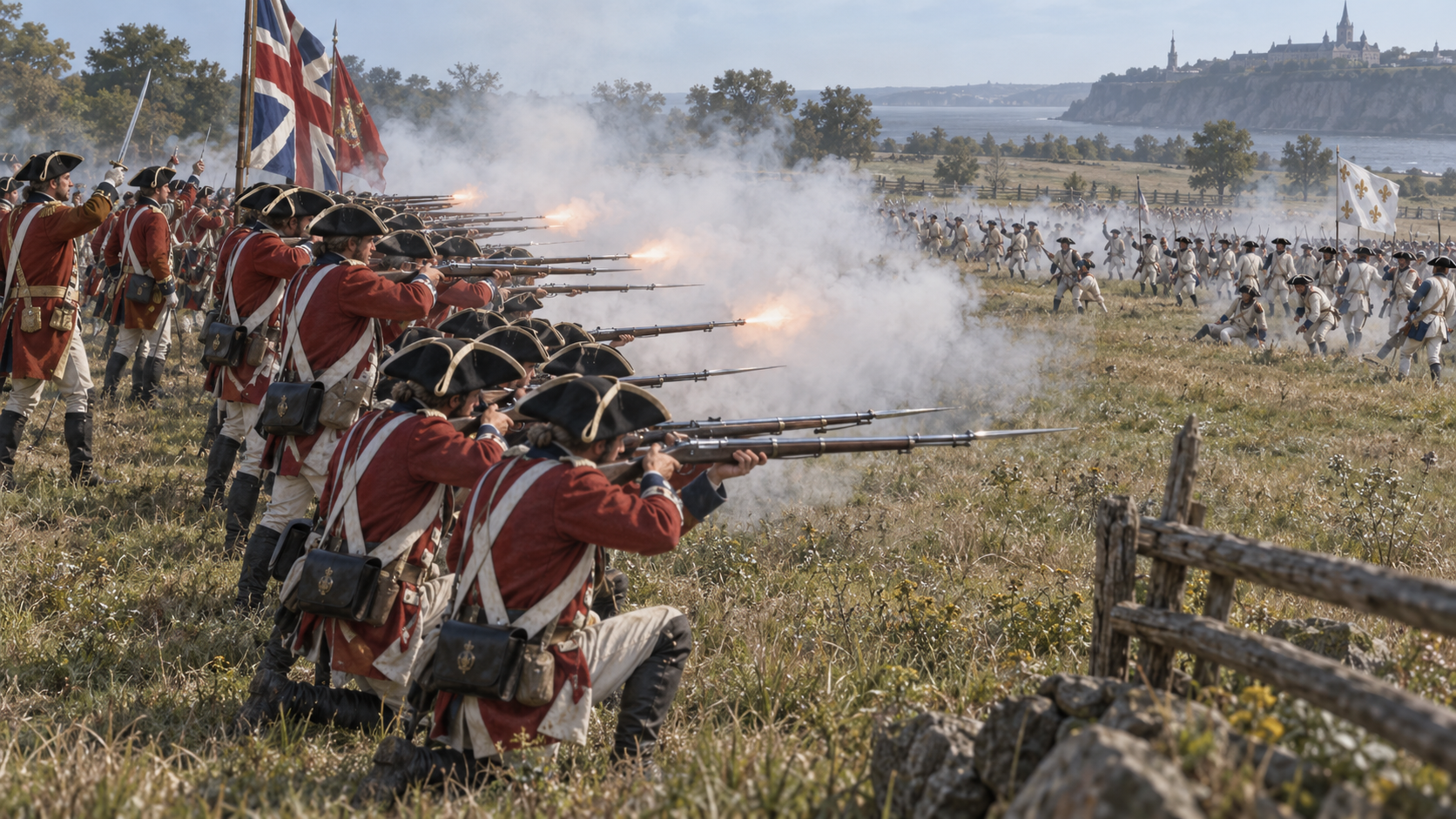
At approximately ten o’clock, the French advanced across uneven ground. The regular battalions attempted to maintain formation, while many militiamen used the more dispersed fighting methods to which they were accustomed. The advance became increasingly disordered, and French musket fire was delivered unevenly. Wolfe’s infantry remained in two extended ranks, holding its fire as the French approached. When the distance had closed, the British delivered carefully coordinated volleys. The concentrated musket fire tore into the advancing line and enveloped the field in smoke.
British soldiers then moved forward with bayonets as the French formation collapsed. Canadian militia and Indigenous fighters continued to resist from wooded and broken ground, but the principal French force retreated toward Quebec and the Saint-Charles River. The main engagement lasted between fifteen and thirty minutes. British losses were substantial, but French casualties were heavier, and the French army had been driven from the field. The Canadian War Museum records roughly 650 French casualties, compared with 58 British soldiers killed and about 600 wounded.
Both commanders were mortally wounded. Wolfe was struck several times and died shortly after learning that the French were retreating. Montcalm was wounded while returning toward Quebec and died the following morning. Their deaths transformed the battle into a powerful legend, but the result depended less upon individual heroism than upon naval power, logistics, battlefield discipline and a series of difficult command decisions.
Quebec surrendered on September 18, five days after the battle. Nevertheless, the conquest of New France was not complete. In April 1760, a reorganized French army under the Chevalier de Lévis defeated the British at the Battle of Sainte-Foy and forced the survivors back behind Quebec’s walls. The French besieged the city, hoping that ships from France would arrive with supplies and reinforcements. Instead, British naval vessels reached Quebec first. Lévis withdrew, and three British armies converged upon Montreal. The city surrendered in September 1760, ending organized French military resistance in Canada.
The wider war continued until the Treaty of Paris in 1763. Under the settlement, France ceded Canada and most of its claims east of the Mississippi River to Britain, while retaining certain fishing rights and small islands in the Gulf of St. Lawrence. New France ceased to exist as a French colony, although its people did not disappear.
This distinction is essential to understanding the battle’s place in Canadian history. The Plains of Abraham produced a change of empire, not the destruction of French Canadian society. Most inhabitants of the St. Lawrence Valley remained in their homes and parishes. They continued to speak French, practise Roman Catholicism and maintain many established customs. British officials, governing a population that was overwhelmingly French-speaking and Catholic, gradually recognized that permanent rule would require accommodation as well as authority.
That accommodation became visible in the Quebec Act of 1774. The act protected the free practice of Catholicism, permitted Catholics to hold public office under a modified oath and restored French civil law in private matters while retaining English criminal law. These arrangements were partly pragmatic, but they created the foundations of Canada’s distinctive combination of legal, religious and cultural traditions. Quebec retained a civil-law system while the other provinces generally developed under English common law.
The conquest also affected the future of British North America during the American Revolution. By protecting important French Canadian institutions, British authorities hoped to secure the population’s loyalty and prevent Quebec from joining the rebellion of the Thirteen Colonies. Most French Canadians remained neutral when American forces invaded in 1775–76. The survival of British power north of the new United States helped establish the separate political space within which Canada would later develop.
The consequences for Indigenous peoples were profound and frequently devastating. France’s defeat removed one of the principal European powers with which Indigenous nations had formed diplomatic, commercial and military relationships. Britain’s new dominance altered the balance of power throughout the Great Lakes and Ohio Valley. Indigenous nations continued to resist colonial expansion, most notably during the conflict commonly associated with Pontiac in 1763, but the disappearance of French imperial competition weakened their ability to play one European power against another.
The Battle of the Plains of Abraham therefore occupies a complicated place in Canadian memory. For Britain, it became a celebrated imperial victory. For many French Canadians, it represented conquest, military defeat and the loss of political control. For Indigenous peoples, it was part of a broader imperial struggle that accelerated the expansion of British settlement and authority across their territories. Each perspective forms part of the historical record.
The battle did not make modern Canada inevitable. Confederation remained more than a century away, and the relationship between French- and English-speaking peoples would repeatedly produce political conflict. Nevertheless, the conquest created the circumstances in which two major European linguistic and legal traditions would have to coexist under a single political authority. The resulting compromises—sometimes generous, sometimes reluctant and frequently contested—became central to the development of Canadian federalism, bilingualism and minority rights.
The enduring importance of the Plains of Abraham lies not simply in the British victory or the deaths of Wolfe and Montcalm. It lies in what followed: the survival of French Canada under British rule, the preservation of a distinct society in Quebec and the gradual construction of institutions capable of containing more than one language, legal tradition and historical memory. The battle changed the empire that governed Canada, but the accommodations made after the conquest helped shape the country Canada would ultimately become.