

The Battle of Queenston Heights: The Invasion That Failed
13 October 1812 — Sir Isaac Brock, the defence of Upper Canada, and the battle that helped determine the fate of British North America.
The Morning of Invasion
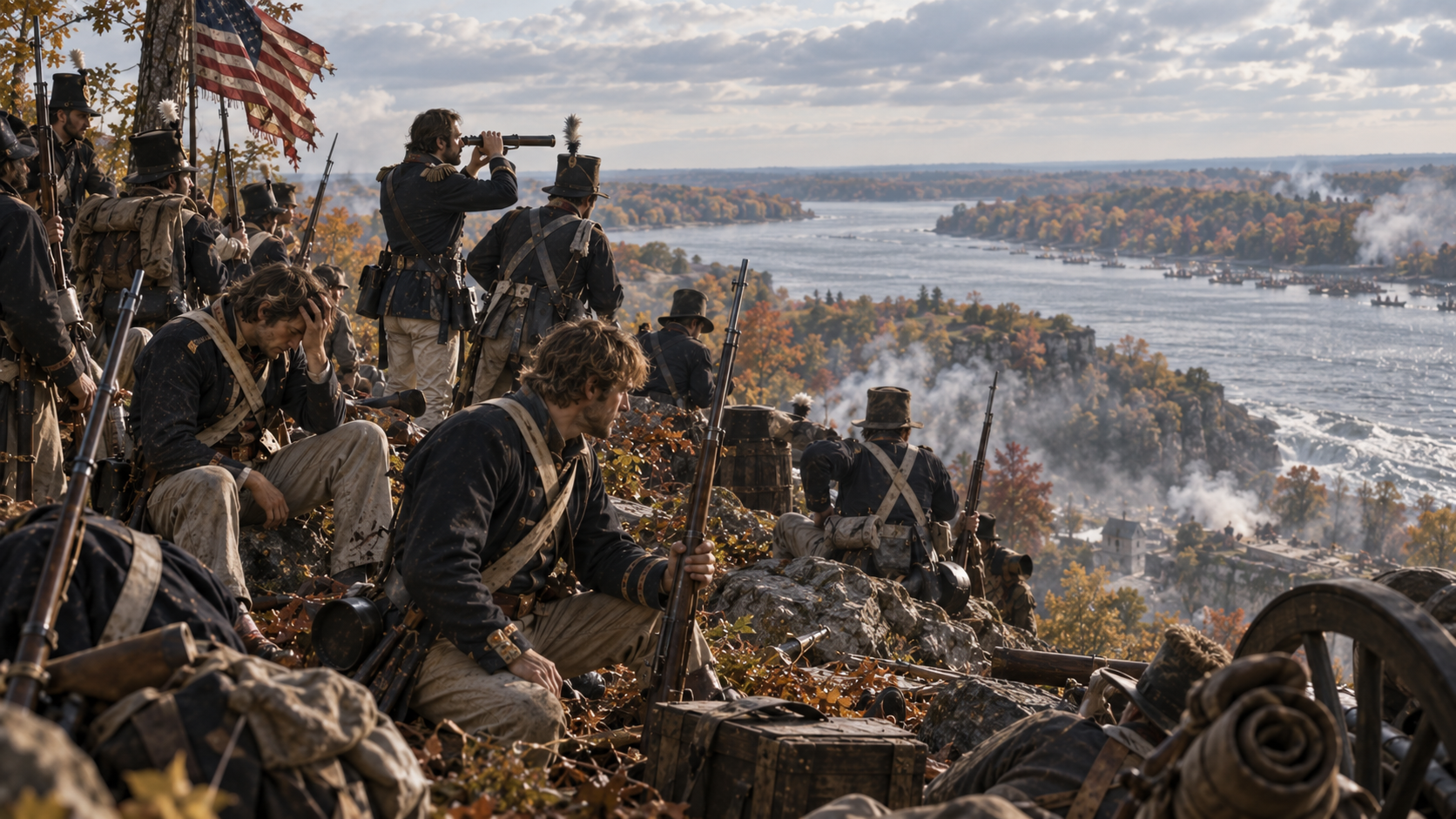
Before dawn on 13 October 1812, small boats began moving across the dark waters of the Niagara River. Their passengers were American soldiers, regulars and militiamen, carrying muskets, ammunition and the ambitions of a republic determined to defeat Great Britain in North America.
The men embarked from Lewiston, New York. Across the river lay Queenston, a modest village at the foot of the Niagara Escarpment. Beyond the village stretched the roads and settlements of Upper Canada, a British colony whose survival was now in question.
The crossing was dangerous even without an enemy. The Niagara River was swift and treacherous, its currents capable of sweeping a boat downstream before its crew could reach the opposite bank. Above Queenston, the escarpment rose steeply from the valley, its summit commanding the river and the village below. British artillery positioned on the heights could strike at approaching boats, while infantry and militia guarded the vulnerable landing places.
Yet the Americans had reason to believe their expedition might succeed.
The United States had declared war upon Great Britain less than four months earlier. American politicians had spoken confidently of conquering Canada, regarding Britain’s scattered garrisons and relatively small colonial population as incapable of sustained resistance.
The campaign had already produced one humiliation. At Detroit, in August 1812, Major-General Isaac Brock and his Indigenous allies under the Shawnee leader Tecumseh had forced an entire American army to surrender.
Now the Americans intended to recover the initiative.
Their commander was Major-General Stephen Van Rensselaer, a wealthy New York politician whose military experience was limited. His army greatly outnumbered the British forces immediately available to oppose him.
The invasion was intended to establish an American foothold on the Canadian side of the Niagara River, seize the high ground and open the way for further operations against British positions along the frontier.
But military plans conceived in headquarters have a tendency to unravel when subjected to geography, weather, human confusion and enemy fire.
By the end of the day, Van Rensselaer’s army would be defeated, hundreds of Americans would be prisoners, and the British commander who had become the symbol of Upper Canada’s resistance would be dead.
Queenston Heights would become one of the defining battles of the War of 1812.[1]
The War Comes to Upper Canada
The origins of the conflict lay in the struggle between Britain and Napoleonic France.
For years, the United States had been caught between the naval policies of the European belligerents. British interference with American commerce, the Royal Navy’s impressment of sailors, and longstanding disputes over British influence among Indigenous nations in the American Northwest generated increasing hostility.
President James Madison and the American Congress finally chose war in June 1812.
Many American leaders regarded the conquest of British North America as a desirable and achievable objective. Capturing Canadian territory might weaken Britain, improve the American bargaining position and eliminate British military influence along the northern frontier.
But the defenders of Upper Canada possessed advantages that American politicians frequently underestimated.
They fought upon familiar ground. They could draw upon established British military institutions, local militia organizations and important Indigenous alliances. Their leaders understood that defeat might mean the permanent loss of the colony.
Above all, they possessed Isaac Brock.
Born in Guernsey in 1769, Brock had spent years serving in British North America. By 1812, he combined command of British military forces in Upper Canada with responsibility for administering the colony.
He was energetic, impatient with excessive caution and convinced that passive defence would invite disaster.
His agreement with Tecumseh at Detroit had been an extraordinary diplomatic and military achievement. The British and Indigenous forces had convinced American commander William Hull that continued resistance was hopeless.
On 16 August 1812, Hull surrendered.
The victory transformed morale in Upper Canada. It also enhanced Brock’s reputation as a commander capable of overcoming superior numbers through speed, surprise and audacity.
Yet Detroit had not ended the war.
American forces were concentrating along the Niagara frontier, where an invasion could threaten Fort George, sever British communications and perhaps open the road toward the heart of Upper Canada.
Brock returned to Niagara determined to meet the danger.
The next American offensive would test both his judgement and the fragile confidence he had helped create.[2]
Two Armies on the Niagara
By early October 1812, thousands of American soldiers were gathered on the eastern bank of the Niagara River.
Van Rensselaer’s command included New York militia and United States regular troops, but these were not necessarily components of a unified and experienced field army.
They possessed different obligations, training standards and commanders. Rivalries between senior officers complicated cooperation, and American preparations were hindered by disagreements about strategy and the authority of militia commanders.
Brigadier-General Alexander Smyth, commanding American regulars farther south, was an especially troublesome figure in the planning of the Niagara campaign.
Van Rensselaer nevertheless determined to cross the river at Queenston.
The village was strategically important because it lay near a principal route linking British positions along the Niagara frontier. Control of Queenston Heights would also provide a valuable position from which American troops could dominate the surrounding country.
An attempted crossing on 11 October failed before the principal attack began, owing in part to problems with the boats and their equipment.
Van Rensselaer tried again on 13 October.
British officers were aware that the Americans might attack, although the precise time and location remained uncertain.
Major Thomas Evans had become suspicious during a visit to the American side under a flag of truce on 12 October. He observed evidence suggesting that another crossing was being prepared.
Brock instructed his subordinates to remain alert.
The immediate British defence of Queenston consisted of detachments of the 49th Regiment of Foot and local militia, supported by artillery.
Their numbers were small compared with the army assembled across the river.
But the defenders possessed the heights.
From the Redan Battery, British guns overlooked the crossing and could inflict severe losses upon soldiers confined in small boats on the river.
The Americans therefore faced two problems: they had to cross the water under fire, and they had to seize the elevated ground from which the British could destroy them.
The battle began in darkness.[3]
The Americans Cross the River
Shortly before dawn, the first American boats pushed away from Lewiston.
The operation quickly became confused.
Some boats missed their intended landing points. Others were carried downstream by the current. British artillery opened fire, and the sound of cannon echoed through the valley.
American soldiers crowded into boats that offered little protection from grapeshot and musketry. The crews struggled with the river while their passengers waited helplessly to reach the Canadian shore.
The British defenders responded vigorously.
Captain James Dennis of the 49th Regiment directed part of the resistance around the landing places, while the artillery on the heights fired upon the approaching boats.
Yet despite the confusion and casualties, American troops succeeded in reaching the western bank.
They established a foothold near Queenston, fighting their way into the village and the ground below the escarpment.
The decisive opportunity came when American soldiers discovered a path ascending the steep slope beyond the principal British defences.
Captain John E. Wool and other American officers helped lead troops up the difficult terrain.
Moving through the trees and broken ground, the Americans reached the summit and approached the Redan Battery from an unexpected direction.
The defenders suddenly found themselves threatened from behind.
The battery fell.
What had begun as a dangerous and disordered river crossing now appeared to offer the Americans an extraordinary opportunity.
They possessed the high ground overlooking Queenston.
British guns that had previously dominated the crossing could no longer be relied upon to protect the river.
For a brief but critical period, the invaders seemed to hold the key to the Niagara frontier.[4]
Brock Rides to Queenston
At Fort George, several kilometres downstream, Isaac Brock learned that the Americans were crossing the river.
He immediately rode toward Queenston.
The British commander travelled rapidly along the Niagara road, passing local militia detachments who were also moving toward the fighting.
One of those militiamen, John Beverley Robinson, later described encountering the general as he hurried to the battlefield.
Robinson remembered Brock waving his hand and urging the men onward before continuing toward Queenston.
The account provides a revealing glimpse of Brock’s character: a commander unwilling to remain at headquarters when his troops were facing an immediate crisis.
When he arrived near Queenston, he discovered that the tactical situation had deteriorated.
American troops were established on the heights. The Redan Battery had been captured. If the invaders could continue landing men and supplies, their position might become increasingly difficult to dislodge.
Brock confronted an urgent decision.
He could wait for reinforcements from Fort George and other posts along the frontier, allowing the Americans more time to strengthen their bridgehead. Or he could attempt an immediate counterattack with the troops available.
He chose to attack.
The decision has often been presented as evidence of rashness. Yet it also reflected a genuine military dilemma. Brock understood that allowing an enemy to consolidate control of the heights could jeopardize the entire British defence of Niagara.
He assembled a small force of regular soldiers from the 49th Regiment and Canadian militia.
Then he led them toward the American position.
The British advanced uphill against troops possessing the advantage of elevation and cover.
Brock was conspicuous in his officer’s uniform. His height, commanding presence and determination to lead from the front made him an unmistakable target.
American soldiers opened fire.
During the attack, a musket ball struck Brock in the chest.
The forty-three-year-old general fell and died almost immediately.
The man whose success at Detroit had given Upper Canada renewed hope was dead before the battle had reached its decisive stage.[5]
The Death of Brock and the Failure of the First Counterattack
Brock’s death has become one of the most frequently depicted moments in Canadian military history.
Artists have portrayed him falling from a horse, collapsing into the arms of his soldiers or delivering a final command while wounded.
The famous words traditionally associated with his death, “Push on, brave York volunteers,” remain part of Canadian historical memory.
But the evidence supporting the familiar deathbed scene is uncertain.
Contemporary accounts indicate that Brock was leading his men on foot when he was fatally wounded and that death came quickly. The famous words may have originated from encouragement he gave militia soldiers earlier that morning, rather than from any final speech.
Historical memory had begun transforming the commander into a legend almost before the battle ended.
Yet the immediate consequences of his death were entirely practical.
British troops fell back.
Lieutenant-Colonel John Macdonell, Brock’s young aide-de-camp, attempted to recover the position by organizing another counterattack.
Macdonell was a prominent Upper Canadian officer and lawyer whose personal loyalty to Brock was matched by a determination to continue fighting.
He gathered a small force of regulars and militia and pressed forward against the American troops holding the heights.
For a moment, the attack appeared to make progress.
But the Americans still possessed superior numbers in the immediate fighting, and the British were advancing across difficult ground against determined resistance.
Macdonell was wounded and fell from his horse. He died from his wounds shortly afterward.
Other officers were also wounded, and the counterattack failed.
By mid-morning, the Americans remained in possession of Queenston Heights.
The British had lost Brock and Macdonell, two officers whose personal leadership had been important to the colony’s military organization.
What had begun as a relatively small American landing had become a serious military crisis.
Yet the Americans had failed to exploit their success.
Their army remained divided by the Niagara River.
And the battle was far from over.[6]
John Norton and the Indigenous Defence of the Heights
The familiar story of Queenston Heights has long centred upon Brock’s death.
But the battle was not won by Brock.
It was won after his death, through the combined actions of British regulars, Canadian militia, Black volunteers and Indigenous warriors whose contribution proved indispensable.
Among the most important of the Indigenous leaders was John Norton, known in Mohawk as Teyoninhokarawen.
Norton was born to a Cherokee father and a Scottish mother and had been adopted into the Mohawk community associated with Joseph Brant. He became an influential political and military leader among the Haudenosaunee of the Grand River.
He understood that the War of 1812 represented much more than a dispute between Britain and the United States.
For Indigenous nations, American expansion threatened lands, communities and political independence.
The alliance with Britain was therefore rooted in strategic considerations of Indigenous survival, sovereignty and diplomacy, not simply loyalty to the Crown.
Historian Donald E. Graves captures this distinction in his assessment of Norton:
“John Norton’s loyalty was always to the Indigenous people.”
The British alliance offered Norton and many other Indigenous leaders a means of resisting American expansion, although Indigenous opinion was never uniform.
The Haudenosaunee Confederacy itself was divided by the international boundary, with communities on both sides of the war.
Some sought neutrality. Others supported different belligerents.
On 13 October, Norton and warriors from the Grand River region advanced toward Queenston Heights.
John Brant, the son of Joseph Brant, was among the Indigenous leaders participating in the fighting.
After Brock’s death, Norton’s warriors climbed toward the American position, taking advantage of the woods, fields and irregular ground on the summit.
Their initial force numbered approximately eighty men, although additional Indigenous warriors participated during the day.
They confronted an enemy many times their strength.
Yet the disparity in numbers did not prevent them from conducting an effective campaign of harassment and manoeuvre.
Norton recognized that the Americans needed time to organize their captured position, deploy artillery and prepare to resist a counterattack.
He intended to deny them that time.
His warriors attacked from cover, fired upon exposed groups of American soldiers and repeatedly forced the enemy to respond to threats along the flanks.
Their movements prevented the Americans from consolidating their position with confidence.
Norton’s own account, written after the war and published in modern scholarly editions, preserves the urgency of the fighting.
At one moment, describing an attack, he wrote:
“The enemy fired. We closed, and they ran.”
It was a brief sentence, but it captured the essence of the struggle.
The warriors were advancing against a numerically superior enemy, engaging from advantageous positions and withdrawing when the balance of the fighting required it.
They were not merely supporting British soldiers. For several critical hours, they performed an essential independent military function.
Historian Carl Benn, editor of Norton’s wartime memoir, emphasizes that these Indigenous operations “contributed greatly to the British victory.”
Without them, the Americans might have enjoyed the time and freedom necessary to establish a substantially stronger position on the heights.
Instead, the invaders remained under pressure throughout the middle of the day.[7]
The American Plan Begins to Collapse
Across the Niagara River, Stephen Van Rensselaer confronted a growing disaster.
The American soldiers who had crossed successfully were now holding an important position on Canadian soil. Yet the force that was supposed to reinforce them remained largely on the New York shore.
The invading army was fragmented.
The first crossing had required small boats, operating under artillery and musket fire. Maintaining a steady flow of reinforcements, ammunition and supplies across the river had proved difficult.
American commanders also struggled with the divided character of their army.
Many militiamen refused to cross into Canada, maintaining that their legal obligations did not require service beyond the territory of the United States.
The precise constitutional merits of their objections were disputed, but the effect upon the expedition was unmistakable.
Van Rensselaer could not compel his entire force to carry out the invasion.
The refusal of significant numbers of soldiers to cross the river deprived the American troops on the heights of desperately needed reinforcements.
The army that had been assembled to conquer Upper Canada was discovering that superiority in numbers meant little if its soldiers could not be brought into action.
On the Canadian side, meanwhile, the American position was growing more precarious.
Winfield Scott, a young American officer who would later become one of the most important generals in United States military history, assumed a prominent role in organizing the troops on the heights.
He attempted to establish a defensible position and prepare the men for the inevitable British counterattack.
But Norton’s warriors continued their pressure, the American units were disorganized, and the Niagara River increasingly resembled an obstacle to retreat rather than a dependable line of support.
The Americans held the heights.
They did not possess the means to hold them indefinitely.
And British reinforcements were approaching.[8]
Roger Hale Sheaffe Takes Command
With Brock dead, command of the British forces passed to Major-General Roger Hale Sheaffe.
Sheaffe was a very different commander from Brock.
Where Brock was remembered for audacity and aggressive personal leadership, Sheaffe was more deliberate and methodical.
He understood that another direct assault up the face of the escarpment would be costly and might fail.
Instead, he began assembling regular troops, Canadian militia, artillery and other available forces.
Reinforcements moved from Fort George and Chippawa toward Queenston.
Among the defenders were members of Runchey’s Coloured Corps, a company composed of free Black men serving in the Upper Canadian militia. Its members, including men associated with Richard Pierpoint, formed part of the wider military effort to defend the colony.
Their participation illustrates the diversity of the forces defending Upper Canada.
The British army was not fighting alone. It relied upon local militia, Black volunteers and Indigenous allies with distinct experiences, interests and reasons for opposing the American invasion.
Sheaffe devised a manoeuvre intended to avoid the worst of the American defences.
Rather than advancing directly through Queenston and charging uphill along Brock’s unsuccessful route, he moved his forces inland and toward the western approaches to the heights.
The terrain was critical.
Woodland and cultivated fields provided opportunities to approach the American position without exposing the entire British force to artillery fire from across the river.
Norton’s warriors had already demonstrated the value of using these approaches.
Sheaffe now employed a larger, more organized force to execute the decisive counterattack.
By the middle of the afternoon, British and allied forces were positioned to attack the American bridgehead.
The invasion had reached its final crisis.[9]
The Afternoon Counterattack
Shortly after three o’clock, the British-led attack began.
The defenders advanced across the plateau above Queenston, with regular troops forming the principal line and militia, light infantry and Indigenous warriors operating on the flanks.
The Americans attempted to resist.
Musket volleys echoed across the fields. Smoke obscured portions of the battlefield. British artillery supported the advance while the infantry pressed toward the enemy.
But the American position had been weakened by hours of combat.
The soldiers were tired. Units had become separated. The efforts of Norton’s warriors had prevented the Americans from preparing their defences as effectively as they had hoped.
The British advance threatened to overwhelm what remained of their organized resistance.
Sheaffe’s troops pressed forward.
Indigenous warriors attacked from the wooded flank, intensifying the pressure upon an enemy that had already begun looking toward the river for escape.
The American line broke.
Soldiers retreated toward the steep slopes above the Niagara, only to discover that the boats they needed were either insufficient or no longer waiting at the Canadian shore.
Some attempted to scramble down the dangerous descent.
Others entered the river.
Many were trapped between the advancing British and allied forces and the cliffs overlooking the water.
The battlefield had become a narrow enclosure from which retreat was almost impossible.
John Beverley Robinson, who had participated in the day’s fighting, later described the emotional impact of the battle as leaving a terrible impression upon his imagination.
His account reminds us that the triumph celebrated afterward was accompanied by appalling scenes of suffering.
American soldiers surrendered in large numbers.
Among the prisoners were senior officers, including Winfield Scott.
By late afternoon, the battle was over.
Parks Canada records 958 American prisoners captured in the final British victory.
The invasion had failed.
The heights belonged once again to the defenders of Upper Canada.[10]
A Victory Bought at a Terrible Price
Queenston Heights was an important military victory, but it was not an inexpensive one.
The Americans suffered substantial losses in killed, wounded and captured. The number of prisoners alone represented a major defeat for the expedition.
British and allied losses were considerably smaller, yet they included officers and Indigenous warriors whose deaths carried lasting consequences.
Brock had been killed in the morning fighting. John Macdonell died from his wounds.
Among the Indigenous dead were Cayuga, Onondaga and Oneida warriors whose names appear in the modern national commemoration of the battlefield.
Their deaths demonstrate that the Indigenous contribution to the victory was paid for in lives as well as military effort.
For Upper Canada, the death of Brock was especially painful.
He had commanded the colony’s defence during its most dangerous opening months of war. His victory at Detroit had raised morale, and his personal energy had helped persuade a frightened population that resistance was possible.
Now he was gone.
On 16 October, Brock and Macdonell were buried with military ceremony at Fort George.
Even the American defenders across the river acknowledged the loss.
A contemporary account recorded that guns at Fort Niagara were fired during Brock’s funeral as a mark of respect for a brave enemy.
The gesture was characteristic of an era in which officers serving opposing nations sometimes recognized courage and professional honour across the divisions of war.
Yet for the people of Upper Canada, the meaning of the funeral was more immediate.
Their colony had survived a second major invasion.
But the commander who had become the symbol of that resistance would not lead them again.[11]
The Battle and the Survival of Upper Canada
The Battle of Queenston Heights did not determine the ultimate outcome of the War of 1812.
The conflict continued for more than two years.
American armies would invade the Niagara frontier again. British positions would be captured and abandoned. Battles at Fort George, Stoney Creek, Beaver Dams, Chippawa, Lundy’s Lane and Fort Erie would demonstrate that neither side possessed an easy road to victory.
Nevertheless, the strategic consequences of Queenston Heights were substantial.
The American offensive of October 1812 had been defeated.
Combined with earlier British and Indigenous successes at Fort Mackinac and Detroit, the victory prevented the United States from establishing a secure position in Upper Canada during the war’s opening campaign.
The result strengthened the morale of British officers, militia commanders and residents whose confidence had been threatened by American military preparations.
It also demonstrated that an American invasion could fail despite superior numbers.
The defenders had exploited geography, local knowledge, effective reinforcements and cooperation among regular troops, militia and Indigenous warriors.
The American army, meanwhile, had suffered from divided command, logistical weakness and an inability to bring its strength across the Niagara River.
Queenston Heights therefore offered an important lesson about the conduct of warfare.
The ability to assemble an army did not guarantee the ability to employ it.
The possession of superior numbers did not ensure victory.
And control of a battlefield feature, however important, meant little without the capacity to defend it against counterattack.
The Americans had seized Queenston Heights.
They had not secured the crossing, reinforced the position or maintained the cohesion of their army.
Their defeat revealed the difference between a successful tactical advance and a sustainable military operation.[12]
The Making of a Canadian Legend
As the nineteenth century progressed, the memory of Queenston Heights became increasingly associated with the figure of Isaac Brock.
His dramatic death provided a powerful subject for artists, writers, politicians and public commemorations.
The battlefield itself gradually became a landscape of national remembrance.
Brock and Macdonell were first buried at Fort George. Their remains were later transferred to a monument on Queenston Heights, and the present Brock’s Monument was completed in 1856.
The enormous stone column above the Niagara River became one of the most recognizable memorials in Canada.
It commemorated the British officer whose courage and sacrifice had become inseparable from the defence of Upper Canada.
Yet the commemorative tradition had limitations.
The familiar paintings frequently placed Brock at the centre of the battle and relegated other participants to the margins.
The role of John Norton and the Haudenosaunee warriors was too often neglected. The contributions of local militia and Black soldiers received comparatively little attention. Sheaffe’s methodical planning and successful final assault were overshadowed by the drama of Brock’s death.
Modern scholarship has broadened that interpretation.
Robert Malcomson’s detailed study, A Very Brilliant Affair: The Battle of Queenston Heights, 1812, reconstructs the engagement as a complicated military operation rather than a simple drama of individual heroism.
The work of historians Carl Benn and Donald E. Graves has also helped restore the Indigenous dimension to the narrative, recognizing that the alliance between the Crown and Indigenous nations was a product of diplomacy and strategic interests rather than uncomplicated colonial loyalty.
John Norton’s journal is particularly valuable because it allows historians to examine the battle through the perspective of an Indigenous commander.
The warriors who fought beside the British were defending their own interests as well as contributing to the survival of Upper Canada.
The later history of the region would reveal the limits of British promises and the difficulties Indigenous nations faced as settlement and colonial authority expanded.
Understanding those consequences does not diminish the military importance of Queenston Heights.
It makes the battle’s history more complete.[13]
The Heights Remembered
Today, Brock’s Monument rises above the Niagara River, overlooking the ground on which the battle was fought.
The river still flows between Queenston and Lewiston. The escarpment still dominates the valley. Although roads, settlements and modern infrastructure have transformed the landscape, the fundamental geography that shaped the battle remains recognizable.
Visitors can look across the river toward the American shore and imagine the difficulties confronting the soldiers who attempted the crossing before dawn on 13 October 1812.
They can stand above Queenston and understand why the Redan Battery mattered, why the American ascent of the escarpment was dangerous, and why the heights became the decisive objective of the day.
They can also consider how quickly the course of a battle can change.
The Americans crossed the river, seized the high ground and killed the British commander.
For several hours they appeared to possess the initiative.
Yet by late afternoon, their army had collapsed.
The battle was decided not by a single charge, a single commander or a single act of courage, but by the interaction of geography, leadership, battlefield decisions, logistical failure and cooperation among the forces defending Upper Canada.
Brock’s death gave the battle its most enduring image.
John Norton and his warriors helped prevent the Americans from turning their early success into a lasting victory.
Roger Hale Sheaffe brought the surviving British forces into position and delivered the decisive attack.
Canadian militia and Black volunteers helped defend a colony whose future had seemed uncertain only months before.
Together, these forces defeated an invasion at one of the principal gateways into Upper Canada.
The Battle of Queenston Heights was therefore much more than the death of a famous general.
It was a turning point in the campaign of 1812, a demonstration of the importance of Indigenous alliances, and an event whose memory would become part of the developing historical identity of Canada.
On that October morning, soldiers crossed the Niagara River believing that the conquest of Upper Canada lay before them.
By evening, the invaders had surrendered.
Their army was broken.
And upon the heights above Queenston, amid the dead and wounded, the defenders had secured a victory whose consequences would reach far beyond the battlefield.
Historical Notes and References
Chicago Manual of Style — Notes and Bibliography.
1. Parks Canada, “Culture and History: Queenston Heights National Historic Site,” Government of Canada, https://parks.canada.ca/lhn-nhs/on/queenston/culture. See also Robert Malcomson, A Very Brilliant Affair: The Battle of Queenston Heights, 1812 (Toronto: Robin Brass Studio, 2003).
2. J. Mackay Hitsman, The Incredible War of 1812: A Military History, updated by Donald E. Graves (Toronto: Robin Brass Studio, 1999); Pierre Berton, The Invasion of Canada, 1812–1813 (Toronto: McClelland and Stewart, 1980).
3. Brock University Library, Archives and Special Collections, “Battle at Queenston,” Battle of Queenston Heights digital exhibition, https://exhibits.library.brocku.ca/s/battle-of-queenston-heights/page/battle-at-queenston; Malcomson, A Very Brilliant Affair.
4. Brock University Library, “Battle at Queenston”; Library and Archives Canada, British military and naval records, RG 8, C Series, as described in Library and Archives Canada, “War of 1812,” https://www.bac-lac.gc.ca/eng/discover/military-heritage/war-of-1812/pages/introduction.aspx.
5. John Beverley Robinson, eyewitness account dated 14 October 1812, reproduced in Robert Henderson, ed., “An Account of the Battle of Queenston Heights, October 13, 1812,” https://www.warof1812.ca/queenstn.htm; Brock University Library, “Battle at Queenston.”
6. Brock University Library, “Battle at Queenston,” including its discussion of the traditional accounts of Brock’s dying words and the wounding of Lieutenant-Colonel John Macdonell; Parks Canada, “Culture and History.”
7. Donald E. Graves, quoted in Caleb Burney, “Man of Three Worlds,” Spoke, 10 December 2019, https://spokeonline.com/2019/12/man-of-three-worlds/; Carl Benn, “Leading the Warriors on Queenston Heights: The Account of Teyoninhokarawen,” Friends of Fort York, 31 October 2019, https://fortyorkfoundation.ca/newsletter/leading-the-warriors-on-queenston-heights-the-account-of-teyoninhokarawen/. Norton’s quotation is reproduced in Benn’s edited excerpt. See also John Norton, A Mohawk Memoir from the War of 1812: John Norton—Teyoninhokarawen, edited by Carl Benn (Toronto: University of Toronto Press, 2019).
8. Brock University Library, “Battle at Queenston”; Wesley B. Turner, The War of 1812: The War That Both Sides Won, 2nd ed. (Toronto: Dundurn, 2000); Malcomson, A Very Brilliant Affair.
9. Parks Canada, “Culture and History”; Brock University Library, “Battle at Queenston”; Carl Benn, The Iroquois in the War of 1812 (Toronto: University of Toronto Press, 1998).
10. John Beverley Robinson, eyewitness account, 14 October 1812, edited by Henderson; Parks Canada, “Culture and History,” which records 958 American prisoners; Benn, “Leading the Warriors on Queenston Heights.”
11. Brock University Library, “Aftermath,” Battle of Queenston Heights digital exhibition, https://exhibits.library.brocku.ca/s/battle-of-queenston-heights/page/aftermath; Parks Canada, “Queenston Heights National Historic Site of Canada,” Directory of Federal Heritage Designations.
12. Hitsman, The Incredible War of 1812; Malcomson, A Very Brilliant Affair; Turner, The War of 1812.
13. Brock University Library, “Legacy,” Battle of Queenston Heights digital exhibition, https://exhibits.library.brocku.ca/s/battle-of-queenston-heights/page/legacy; Benn, The Iroquois in the War of 1812; Norton, A Mohawk Memoir from the War of 1812.
Bibliography
Primary and Archival Sources
Brock University Library. Archives and Special Collections. War of 1812 Correspondence. Includes eyewitness accounts associated with Queenston Heights by Captain John Powell of the 1st Lincoln Militia and W. Woodruff, and material concerning American Captain Peter Ogilvie. https://exhibits.library.brocku.ca/s/war-of-1812/page/correspondence.
Evans, Thomas. Report to the War Office concerning the Battle of Queenston Heights. Fort George, 15 October 1812. Thomas Evans Collection, R4152-0-5-E, formerly MG24-F70. Library and Archives Canada, Ottawa. https://recherche-collection-search.bac-lac.gc.ca/eng/Home/Record?IdNumber=101156&app=fonandcol.
Library and Archives Canada. British Military and Naval Records, RG 8, C Series. Records of British forces in Canada during the War of 1812.
Norton, John. The Journal of Major John Norton, 1816. Edited by Carl F. Klinck and James J. Talman. Toronto: Champlain Society, 1970.
Norton, John. A Mohawk Memoir from the War of 1812: John Norton—Teyoninhokarawen. Edited by Carl Benn. Toronto: University of Toronto Press, 2019.
Robinson, John Beverley. Eyewitness account of the Battle of Queenston Heights, 14 October 1812. Reproduced in Robert Henderson, ed., “An Account of the Battle of Queenston Heights, October 13, 1812.” https://www.warof1812.ca/queenstn.htm.
Scholarly Books and Historical Studies
Benn, Carl. The Iroquois in the War of 1812. Toronto: University of Toronto Press, 1998.
Benn, Carl. “Leading the Warriors on Queenston Heights: The Account of Teyoninhokarawen.” Friends of Fort York, 31 October 2019. https://fortyorkfoundation.ca/newsletter/leading-the-warriors-on-queenston-heights-the-account-of-teyoninhokarawen/.
Berton, Pierre. The Invasion of Canada, 1812–1813. Toronto: McClelland and Stewart, 1980.
Hitsman, J. Mackay. The Incredible War of 1812: A Military History. Updated by Donald E. Graves. Toronto: Robin Brass Studio, 1999.
Malcomson, Robert. A Very Brilliant Affair: The Battle of Queenston Heights, 1812. Toronto: Robin Brass Studio, 2003.
Turner, Wesley B. The War of 1812: The War That Both Sides Won. 2nd ed. Toronto: Dundurn, 2000.
Government, Archives and Institutional Sources
Brock University Library. “Aftermath.” Battle of Queenston Heights digital exhibition. https://exhibits.library.brocku.ca/s/battle-of-queenston-heights/page/aftermath.
Brock University Library. “Battle at Queenston.” Battle of Queenston Heights digital exhibition. https://exhibits.library.brocku.ca/s/battle-of-queenston-heights/page/battle-at-queenston.
Brock University Library. “Legacy.” Battle of Queenston Heights digital exhibition. https://exhibits.library.brocku.ca/s/battle-of-queenston-heights/page/legacy.
Library and Archives Canada. “War of 1812.” Government of Canada. https://www.bac-lac.gc.ca/eng/discover/military-heritage/war-of-1812/pages/introduction.aspx.
Parks Canada. “Culture and History: Queenston Heights National Historic Site.” Government of Canada. https://parks.canada.ca/lhn-nhs/on/queenston/culture.
Parks Canada. “Norton, John (Teyoninhokarawen) National Historic Person.” Directory of Federal Heritage Designations. https://www.pc.gc.ca/apps/dfhd/page_nhs_eng.aspx?id=13011.
Spoke. Burney, Caleb. “Man of Three Worlds.” 10 December 2019. https://spokeonline.com/2019/12/man-of-three-worlds.