

The Battle of Vimy Ridge: Victory, Sacrifice and the Making of a Canadian Legend
9–12 April 1917
The Canadian Corps, the struggle for Vimy Ridge and the battle that became a defining symbol of Canada’s experience in the First World War.
The Morning of the Assault
In the darkness before dawn on 9 April 1917, thousands of Canadian soldiers waited beneath the shattered landscape of northern France. Some stood in narrow trenches filled with mud and cold water. Others sheltered in deep underground tunnels, listening to the distant rumble of artillery and the occasional explosion of a German shell. Their rifles had been cleaned, their ammunition checked, their equipment assembled with the deliberate care of men who understood that the smallest oversight might soon prove fatal.
Above them stood Vimy Ridge, a long, commanding elevation overlooking the Douai Plain. For more than two years it had remained in German hands. British and French efforts to dislodge its defenders had failed, leaving the surrounding countryside scarred by artillery, broken trenches and the remains of thousands of soldiers.
Now the task had fallen to the Canadians.
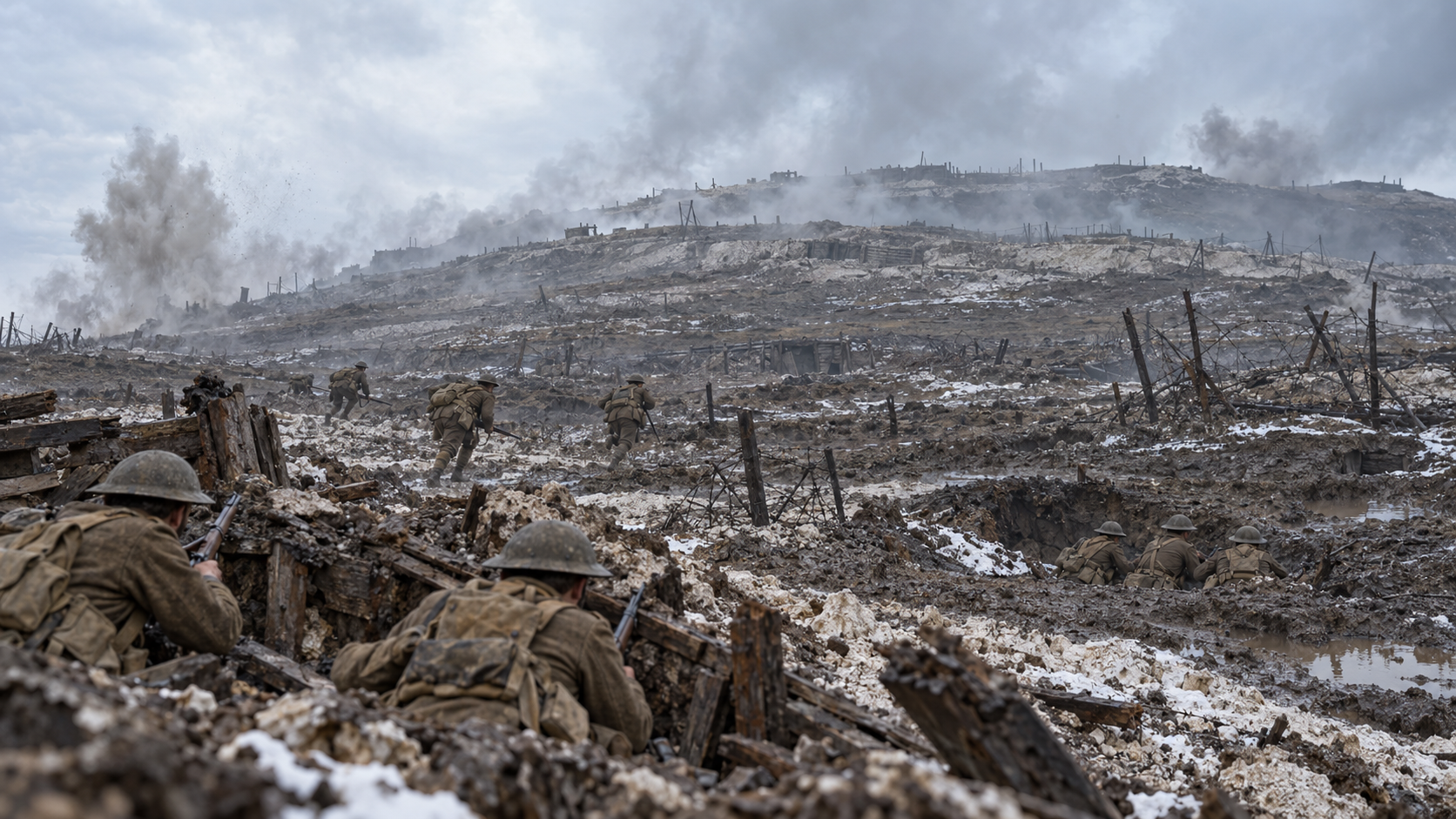
It was Easter Monday. The spring of 1917 had been unusually cold, and the weather was unsettled. Rain, sleet and intermittent snow had turned much of the battlefield into a wasteland of chalk, water and mud. Underfoot lay the accumulated destruction of industrial warfare: shell craters, collapsed dugouts, tangled wire, shattered timber and the debris of abandoned equipment.
In the assembly trenches, officers consulted their watches. Every movement had been calculated in advance. Every battalion possessed a specific objective. Artillery batteries had been assigned carefully timed targets. The success of the operation depended upon thousands of men moving across a devastated landscape in close coordination with an enormous concentration of guns.
At precisely 5:30 a.m., the bombardment erupted.
Hundreds of artillery pieces opened fire, joining the batteries already engaged in the attack. The darkness flashed with explosions. German positions disappeared beneath curtains of earth, smoke and shell fragments.
Canadian infantry climbed from their trenches and began advancing toward the ridge.
For the first time in the war, all four divisions of the Canadian Corps were attacking together in a single operation. Their ranks contained men from nearly every region of Canada, men who had once been farmers, fishermen, miners, clerks, lumbermen, railway workers, teachers and university students.
They had come to France as citizen-soldiers of the British Empire.
On the slopes of Vimy Ridge, they would establish a military reputation that would endure long after the war itself had passed into history.
But the victory would come at a terrible price.
During four days of fighting, 3,598 Canadians would be killed and another 7,004 wounded.
The battle would become one of Canada’s greatest military achievements and one of its most enduring national memories.
Yet on that cold April morning, the men advancing through the shellfire were concerned with something more immediate than national destiny.
They were trying to survive.[1]
Canada Enters the Great War
When the First World War began in August 1914, Canada was a self-governing Dominion within the British Empire. It controlled much of its domestic affairs, but Britain retained responsibility for foreign policy and decisions concerning war and peace.
When Britain declared war upon Germany on 4 August 1914, Canada was consequently at war as well.
The Canadian government nevertheless determined the extent of its military contribution.
Prime Minister Sir Robert Borden’s administration organized the Canadian Expeditionary Force, drawing upon existing militia organizations and an enthusiastic wave of volunteers.
In the autumn of 1914, the first Canadian contingent sailed for Britain.
Many recruits expected a relatively brief war. Few imagined that the struggle would consume more than four years, transform international politics and destroy millions of lives.
By the spring of 1915, Canadian troops were fighting in Belgium.
At the Second Battle of Ypres, Canadian soldiers endured the first large-scale German poison-gas attack on the Western Front. Their defence helped establish the reputation of the Canadian Division, but it also introduced the country’s volunteers to the dreadful realities of industrial warfare.
In 1916, Canadian formations fought at Mount Sorrel and on the Somme.
The Somme offensive became a catastrophe of attrition, in which British, French and German armies suffered immense casualties for territorial gains measured in kilometres.
The Canadians experienced the same terrible conditions as other soldiers on the Western Front. Their infantry learned that courage alone could not defeat fortified machine-gun positions. Their artillery discovered the importance of observation, communications and precise fire. Their officers began developing methods that gave smaller fighting units greater freedom to respond to changing circumstances.
The Canadian Corps expanded from one division into four.
By the end of 1916, it possessed experienced infantry, artillery, engineers, medical personnel, signals units and a growing body of officers who had learned their profession through combat.
These men had survived battles in which poor planning and inadequate coordination had cost thousands of lives.
They were determined not to repeat those mistakes.
When the Canadian Corps moved into the Vimy sector late in 1916, it brought with it the hard lessons of two years of war.[2]
The Importance of Vimy Ridge
Vimy Ridge lies in the Pas-de-Calais region of northern France, northeast of Arras.
It is not a mountain in the conventional sense. Its height, measured above sea level, is modest. But across the relatively flat country surrounding it, the ridge offered an extraordinary military advantage.
From its summit, German observers could look across the Allied positions, monitor roads and railway movements, and direct artillery fire against targets far below.
The ridge extended approximately seven kilometres, rising toward its principal summit at Hill 145.
To the north lay another important feature known to the Canadians as the Pimple.
The Germans had occupied Vimy Ridge since October 1914, transforming it into a formidable defensive position.
They constructed successive trench systems protected by barbed wire and fortified with concrete shelters, machine-gun emplacements and deep underground dugouts.
Communication trenches connected strongpoints, while tunnels and subterranean shelters enabled German troops to survive artillery bombardments and emerge when attackers approached.
The defenders understood that the ridge formed an important part of the German defensive system in the Arras region.
So did the Allies.
French armies had repeatedly attempted to recover the position. Their offensives in 1915 produced enormous casualties and temporary gains, but the Germans retained control of the crucial heights.
The surrounding countryside became an immense military graveyard.
The Canadians would therefore attack ground upon which earlier armies had already expended extraordinary efforts.
But the operation in April 1917 was not an isolated Canadian campaign.
It formed part of the larger British offensive around Arras, coordinated with ambitious French plans farther south.
British commanders hoped to force German troops to defend several threatened sectors, weaken their reserves and perhaps achieve the breakthrough that had eluded both sides for so long.
The Canadian Corps was assigned the capture of Vimy Ridge as one part of that larger operation.
The task was formidable.
But it was not undertaken without preparation.[3]
The Commanders: Byng, Currie and the Canadian Corps
The Canadian Corps at Vimy Ridge was commanded by Lieutenant-General Sir Julian Byng, an experienced British officer who had assumed command in May 1916.
Byng was energetic, popular with his Canadian soldiers and prepared to listen to officers who offered practical solutions to battlefield problems.
He recognized that the Canadians possessed increasing combat experience, but he also understood that enthusiasm could not substitute for thorough planning.
Among his senior subordinates was Major-General Arthur Currie, commander of the 1st Canadian Division.
Currie was an unusual figure among the senior commanders of the British Empire. Born in Ontario, he had built his civilian career in British Columbia before the war, working in business and real estate while serving in the militia.
His rise through the Canadian military establishment had been rapid.
He was not a professional soldier formed exclusively by years of imperial military service. He was an intelligent, practical and increasingly experienced commander who approached battlefield problems with unusual attention to planning, administration and the preservation of manpower.
At Vimy, Currie commanded the 1st Division, not the entire Canadian Corps. He would succeed Byng as corps commander in June 1917.
The other divisional commanders were Major-General Henry Burstall of the 2nd Division, Major-General Louis Lipsett of the 3rd Division, and Major-General David Watson of the 4th Division.
These officers faced different tactical problems along the length of the ridge.
The southern divisions would have to advance substantial distances across relatively open ground. The northern formations would confront the more difficult approaches toward Hill 145 and heavily fortified German positions.
The plan therefore required more than a simple order to advance.
It demanded careful coordination among four divisions, their supporting artillery, engineers and neighbouring British forces.
Byng directed the undertaking, while Currie and other senior officers helped refine its execution.
The operation was distinctly Canadian in its principal attacking formations, but it was not exclusively Canadian in personnel, planning or material support.
British staff officers, infantry formations, artillery units and logistical services also contributed to the assault.
The victory would belong chiefly to the Canadian Corps, but it was achieved within the combined machinery of the British Expeditionary Force.[4]
A New Method of War
Perhaps the most remarkable aspect of the Vimy offensive was not the attack itself, but the preparation that preceded it.
For months, engineers, artillerymen, infantry officers and intelligence staffs worked to transform a complex battlefield into a series of identifiable problems.
German positions were photographed from the air.
Trenches, machine-gun nests, observation posts and suspected artillery emplacements were marked on detailed maps.
Intelligence officers studied the German defensive system, identifying strongpoints and examining how one position supported another.
The Canadian Corps developed a programme of training intended to make every soldier familiar with his responsibilities.
Behind the lines, large models of the battlefield were constructed.
Battalions rehearsed their advance over ground representing German trenches and fortifications. Officers explained objectives, routes and anticipated resistance.
Unlike many earlier attacks, detailed maps were distributed widely among junior officers and non-commissioned officers, and substantial information was provided to ordinary infantrymen.
If officers were killed or wounded, other men would understand the immediate objective and could continue the advance.
The infantry themselves were increasingly organized around complementary weapons and specialist roles.
Riflemen, Lewis machine-gunners, rifle grenadiers and bombers could combine their efforts to overcome localized resistance.
This was not the invention of an entirely new military system. British, French and German armies were also adapting their methods after the terrible experiences of earlier offensives.
But the Canadians applied these developments with unusual thoroughness.
The objective was to replace confusion with knowledge and to give soldiers a realistic opportunity to accomplish their missions.
Tim Cook, in Vimy: The Battle and the Legend, places this preparation at the centre of his interpretation of the Canadian victory.
The men would still need courage.
But courage would now be supported by intelligence, rehearsal, engineering and a carefully organized system of firepower.
The attack was intended to be not merely brave, but effective.[5]
The Underground Army
Beneath the Canadian positions, another immense effort was underway.
Engineers and tunnelling companies constructed or enlarged a network of underground passages designed to bring troops and supplies toward the front without exposing them to German observation and artillery fire.
Some tunnels stretched for hundreds of metres. They contained electric lighting, communications equipment, storage areas and chambers where soldiers could assemble before the attack.
Tracks were laid in portions of the underground system. Supplies could be moved forward, while wounded men could be evacuated toward medical facilities behind the lines.
One of the best-known systems was the Grange Subway, portions of which survive at the Vimy Memorial site.
Above ground, roads were repaired and railway connections improved.
Ammunition, food, water, medical equipment and engineering stores had to be brought forward in quantities sufficient to sustain an assault by an army of approximately 100,000 men.
The preparations extended beyond the combat troops.
Transport drivers, railway workers, engineers, medical personnel and signalmen performed duties that were rarely celebrated in later accounts of the battle but were essential to its success.
Telephone cables connected headquarters, observation posts and artillery batteries.
Signals personnel faced the difficult task of maintaining communications across a battlefield where German shellfire could sever wires in an instant.
The entire operation resembled an immense industrial undertaking, dependent upon organization as much as individual heroism.
A successful assault required the infantry to reach their objectives.
But it also required ammunition, communications, artillery support, food, water and medical assistance to follow them.
The Canadian commanders understood that capturing German trenches would achieve little if the new positions could not be held.
The logistical preparations therefore formed an indispensable part of the battle plan.[6]
The Guns of Vimy Ridge
The greatest single advantage available to the Canadian Corps was artillery.
More than 1,000 Canadian and British guns supported the operation, including field artillery, heavy howitzers and siege batteries.
The concentration represented a degree of firepower that would have been almost unimaginable in the opening months of the war.
Its effectiveness, however, depended upon more than the number of guns.
The artillery had to identify enemy positions, destroy or neutralize German batteries, cut the barbed wire and protect the advancing infantry.
One of the officers closely associated with improvements in Canadian counter-battery fire was Lieutenant-Colonel Andrew McNaughton.
A trained engineer and scientist, McNaughton helped employ sound-ranging, flash-spotting and other techniques to locate German artillery.
By measuring the sound and visible flash of enemy guns from several positions, Allied specialists could calculate their approximate locations and direct counter-battery fire upon them.
These techniques were the result of developments across the Allied armies, not McNaughton’s invention alone. Nevertheless, the Canadian counter-battery organization used them effectively.
Aerial observation also played an important role.
Aircraft and observation balloons gathered information, helped identify enemy positions and assisted artillery commanders in correcting their fire.
The Germans increasingly found that firing their guns risked revealing the position of their batteries.
The preparatory bombardment intensified during the weeks before the attack.
German positions were subjected to sustained shellfire. Wire entanglements were cut, trenches destroyed and defensive installations damaged.
The introduction of the No. 106 instantaneous fuze made artillery more effective against obstacles such as barbed wire because shells could explode upon impact rather than burying themselves in the earth.
The Germans came to remember the final period of intense bombardment as a week of suffering.
But artillery preparation could never guarantee the complete destruction of an elaborate defensive system.
Many German soldiers remained protected in deep dugouts.
Others survived in fortified machine-gun positions.
The infantry would still have to fight its way across the ridge.
Byng understood that the success of the assault depended upon close coordination between the soldiers and the guns.
According to the Canadian War Museum’s account, he warned his officers that the advance had to follow its timetable:
“Chaps, you shall go over exactly like a railroad train, on time, or you shall be annihilated.”
The language was severe.
But it accurately described the danger of losing contact with the artillery.
The guns could protect the infantry only if the infantry moved according to the plan.[7]
The Creeping Barrage
The central feature of the artillery plan was the creeping barrage.
Instead of firing only upon distant targets, the artillery would create a moving curtain of explosions immediately ahead of the advancing infantry.
At predetermined intervals, the barrage would lift and move forward.
The soldiers would follow closely behind it.
The principle was simple. German defenders sheltering underground would be unable to emerge and man their weapons until the artillery fire moved away. If Canadian infantry arrived quickly enough, they could overwhelm the defenders before an organized resistance developed.
The difficulty lay in execution.
The barrage had to move at a rate that allowed infantrymen to cross heavily damaged ground while carrying equipment and weapons.
If the artillery advanced too quickly, the infantry would be left exposed.
If soldiers moved too close to the shellfire, they risked being struck by their own guns.
And if resistance delayed the advance, the carefully established timetable might collapse.
The Canadians therefore rehearsed the operation repeatedly.
Units learned their objectives, the order in which defensive positions were to be assaulted, and the relationship between the advancing infantry and the supporting artillery.
Different phases of the attack were identified by coloured objective lines, including the Red, Black, Blue and Brown Lines.
The plan was complicated, but it had a logical structure.
The artillery would suppress the defenders.
The infantry would advance.
Selected units would capture German positions.
Fresh troops would pass through and continue toward the next objective.
Once the final line had been reached, the attackers would consolidate and prepare to resist counterattacks.
The Canadian Corps had transformed the attack into a carefully sequenced military operation.
At 5:30 on the morning of 9 April, the plan began to unfold.[8]
Easter Monday, 9 April 1917
The opening barrage shattered the morning silence.
For soldiers waiting in the Canadian trenches, the effect was overwhelming.
The guns fired across a broad front, filling the air with the roar of artillery and the sound of shells travelling overhead.
Beyond the Allied positions, German trenches disappeared beneath great columns of earth and smoke.
The infantry climbed out of its trenches.
The first wave numbered roughly 15,000 to 20,000 soldiers, with thousands more following behind.
They advanced across a landscape transformed by years of shellfire.
The ground was broken by immense craters. Sections of trenches had collapsed. Water and mud filled low ground, while splintered timbers and tangled wire obstructed movement.
Some men slipped and fell under the weight of their equipment. Others struggled to climb from shell holes or cross the remains of destroyed defences.
The men had been trained to maintain their pace behind the moving barrage, but the conditions made movement difficult.
German artillery responded.
Machine guns opened fire from positions that had survived the bombardment.
Canadian soldiers fell.
Yet the advance continued.
In the southern portion of the battlefield, the 1st Canadian Division under Arthur Currie faced a particularly long advance.
Its troops moved across successive German defensive positions, often fighting at close range with rifles, machine guns and grenades.
The 2nd and 3rd Canadian Divisions also made substantial progress during the morning.
German resistance varied.
Some defenders emerged from their dugouts to find Canadian soldiers already entering the trenches.
Others fought stubbornly from fortified positions, forcing the attackers to employ grenades, Lewis guns and small-unit manoeuvres.
The battle became a series of local struggles within the larger artillery plan.
A machine gun hidden in a damaged emplacement could hold up an entire section.
A surviving dugout might contain dozens of German soldiers.
Officers and non-commissioned officers were required to make immediate decisions, frequently under intense fire.
The effectiveness of the Canadian training now became evident.
When commanders were killed or wounded, other soldiers took responsibility and continued the advance.
By midday, much of the German defensive system had been captured.
The Canadians had crossed ground that earlier armies had found extraordinarily difficult to overcome.
But the battle was not yet won.[9]
Hill 145: The Strongest Position
On the northern portion of the ridge, the 4th Canadian Division confronted some of the most formidable German defences.
Its principal objective was Hill 145, the highest point of Vimy Ridge and the location upon which the great Canadian memorial would later be constructed.
The terrain was particularly difficult.
German trenches, fortified positions and deep shelters dominated the approaches. Machine guns were carefully positioned to sweep the ground over which Canadian troops would have to advance.
Years of bombardment had left the area broken by craters and collapsed earthworks.
The 4th Division suffered heavily.
The artillery barrage had not eliminated every German strongpoint, and defenders emerging from protected positions were able to bring devastating fire upon advancing Canadian infantry.
Entire groups were pinned down.
Officers were killed or wounded.
The carefully calculated timetable began to break down.
The initial attack failed to secure the whole of Hill 145.
For many of the soldiers involved, the experience was the familiar horror of the Western Front: men advancing under artillery support only to discover that the enemy’s machine guns remained capable of inflicting terrible losses.
Yet other Canadian formations had achieved their objectives, and reinforcements could be brought forward.
The Canadian Corps reorganized its efforts against the remaining German positions.
By 10 April, Hill 145 had been secured.
The capture of the summit deprived the Germans of their most important observation position on the ridge.
The Canadians could now look eastward across the Douai Plain, observing German communications and defensive positions that had previously been concealed from Allied artillery.
The strategic value of the heights had changed hands.
But the Germans still held an important northern feature.
The Pimple remained to be taken.[10]
The Pimple and the Final Victory
The Pimple was a fortified elevation near the northern end of Vimy Ridge.
Its defenders occupied a position from which they could threaten Canadian troops attempting to consolidate the newly captured ground.
The assault upon the Pimple was deliberately postponed until the principal ridge had been secured.
By 12 April, the Canadians were prepared to complete the operation.
Artillery once again provided essential support.
Canadian infantry, with assistance from neighbouring British forces, attacked the remaining German positions.
The defenders had already suffered heavily from the preceding bombardments and the loss of the main ridge.
The Canadian assault succeeded.
By the end of 12 April, the principal objectives assigned to the Canadian Corps had been captured.
German troops had withdrawn to positions farther east.
The Canadians had taken thousands of prisoners and captured artillery, machine guns and other equipment.
Vimy Ridge was in Allied hands.
The military achievement was substantial.
A strongly fortified defensive position, held by the Germans since 1914, had been captured through a carefully planned attack combining artillery, infantry, intelligence, engineering and logistical preparation.
But it was not the decisive breakthrough that Allied commanders had hoped might result from the spring offensives.
The broader Battle of Arras continued.
The French offensive farther south would fail to achieve its ambitious strategic objectives.
The war would continue for another nineteen months.
The Canadians had won an important battle.
They had not ended the struggle.[11]
Courage Beneath the Barrage
The achievement at Vimy Ridge depended upon thousands of individual soldiers, most of whose names have disappeared from popular historical memory.
Some carried rifles and bayonets.
Others served Lewis guns, transported ammunition, repaired telephone wires, operated artillery, carried stretchers or brought food and water forward under fire.
Their duties differed, but all were exposed to the dangers of modern warfare.
Four members of the Canadian Corps received the Victoria Cross for their actions during the battle.
Lance-Sergeant Ellis Sifton of the 18th Battalion displayed extraordinary courage while attacking a German machine-gun position. His actions helped overcome resistance that threatened the advance, but he was killed during the fighting.
Private William Milne of the 16th Battalion likewise attacked German machine-gun positions with remarkable determination. He too was killed.
Private John Pattison of the 50th Battalion distinguished himself by overcoming a German machine-gun position that had been delaying the advance. He survived the battle but was killed later in 1917.
Captain Thain MacDowell of the 38th Battalion displayed a different kind of courage.
Entering a German dugout with only two companions, he persuaded a large group of enemy soldiers to surrender by convincing them that he commanded a much greater force.
The episode became one of the most celebrated individual actions of the battle.
Yet these Victoria Crosses represented only a small part of the courage displayed.
Thousands of Canadians continued fighting while wounded, carried injured comrades to safety, repaired communications under shellfire or advanced despite the loss of officers and friends.
The conduct of ordinary infantry sections often determined whether the larger operation succeeded.
The battle demonstrated not simply the bravery of individual soldiers, but the growing tactical effectiveness of the Canadian Corps.
The men had learned how to combine courage with training, initiative and firepower.
It was this combination that made the Canadian victory possible.[12]
The Human Cost of Victory
The numbers recorded after the battle were immense.
The Canadian Corps suffered 10,602 casualties during the four days of fighting.
Of these, 3,598 were killed and 7,004 wounded.
The greatest proportion of these losses occurred on 9 April, making that day the costliest in Canadian military history.
Behind every number stood a human life.
The dead included young men who had left schools, factories, farms and offices across Canada.
Some had been born in Britain or elsewhere and had emigrated to Canada before the war. Others belonged to families whose roots in the country extended back generations.
They included English-speaking and French-speaking Canadians, Indigenous soldiers and men from immigrant communities.
Some had volunteered from conviction, others from loyalty to Britain, economic necessity, friendship, adventure or a complicated mixture of motives.
The battlefield did not distinguish among them.
A soldier might survive the opening bombardment only to be killed by a concealed machine gun.
Another might cross the ridge successfully and then be wounded while consolidating the position.
Stretcher-bearers struggled through shell holes and damaged trenches to evacuate casualties.
Medical officers and nursing personnel worked within a vast system of field ambulances, casualty clearing stations and hospitals.
For the wounded, survival might require hours or days of treatment, transport and uncertainty.
For families in Canada, the news came slowly.
Newspapers carried accounts of the victory. Communities celebrated the military achievement, often before they understood the losses that had accompanied it.
Then casualty lists began appearing.
Telegram messengers approached familiar houses.
Parents learned that their sons had been killed.
Wives received letters informing them that their husbands would not return.
Children confronted the absence of fathers they might scarcely remember.
The triumph on Vimy Ridge was therefore accompanied by a national experience of grief.
Historians who examine the battle’s importance must recognize both realities.
The Canadians achieved a remarkable operational success.
They paid for it with thousands of lives shattered or extinguished.[13]
The View from the Battlefield
The personal accounts of the men who experienced Vimy provide an essential corrective to the simplified images that later became associated with the battle.
Lieutenant-Colonel Frederick George Scott, a Canadian chaplain, observed the opening attack and later described his experiences in The Great War as I Saw It.
He recalled leaving his quarters in the early morning darkness and making his way toward a position from which he could observe the barrage.
As dawn approached, he understood that the attack represented an event of exceptional importance.
“The honour of our country was at stake,” he wrote.
Scott’s memoir conveys the mixture of anticipation, fear and patriotic conviction experienced by many Canadians who served overseas.
Yet not all soldiers interpreted the battle in the same way.
Some were exhilarated by the success.
Others remembered the dead and wounded more vividly than the captured ground.
Men who had watched friends killed during the advance often found little comfort in official descriptions of victory.
Contemporary records also demonstrate how difficult it could be to understand the full situation from any single position on the battlefield.
An artillery officer might believe the assault had succeeded because the infantry had reached its immediate objectives.
A soldier of the 4th Division might remember the day as a sequence of failed attacks and terrible casualties.
A stretcher-bearer might recall little beyond the wounded men he had struggled to carry away.
Each perspective formed part of the larger history.
The Canadian victory was real.
So was the suffering that accompanied it.
Neither should be allowed to obscure the other.[14]
Was Vimy Ridge a Turning Point?
The military importance of Vimy Ridge has sometimes been exaggerated.
Its capture gave the Allies an important observation position and removed a major feature of the German defensive system near Arras.
It also demonstrated the value of careful preparation, effective artillery support and increasingly sophisticated infantry tactics.
But the battle did not produce a general German collapse.
The larger Allied offensives of the spring of 1917 failed to achieve the decisive breakthrough their planners had anticipated.
Germany continued fighting for another year and a half.
The Canadian Corps would fight major battles at Hill 70, Passchendaele, Amiens, Arras, the Drocourt-Quéant Line and the Canal du Nord before the war ended.
Some of those later operations would produce results of greater immediate strategic importance.
Historian Andrew Iarocci, writing in Legion Magazine, has emphasized this distinction.
“Vimy was no strategic turning point,” he argued.
Iarocci’s assessment does not deny that the Canadians won an important battle. Rather, it challenges the assumption that the capture of the ridge transformed the course of the entire war.
There is a significant difference between a tactical or operational victory and a decisive strategic achievement.
Vimy was an exceptional Canadian success within a larger Allied campaign that failed to produce the expected results.
Arthur Currie himself later questioned the widespread belief that Vimy was the greatest victory of the Canadian Corps.
In correspondence from April 1922, Currie argued that other Canadian victories had produced greater military consequences and demonstrated the Corps’ growing effectiveness more clearly.
The Canadian victories of the Hundred Days in 1918 were particularly important.
Historians therefore continue debating how Vimy should be ranked among Canada’s First World War achievements.
What cannot reasonably be disputed is the battle’s significance in the development of the Canadian Corps as a highly effective fighting formation.
Its methods would influence later operations.
Its success strengthened the army’s reputation.
And its memory became far more powerful than its immediate strategic consequences.[15]
The Birth of a Nation?
The claim that Canada was born as a nation at Vimy Ridge has become one of the best-known statements in Canadian historical memory.
The expression is closely associated with Alexander Ross, who commanded the 28th Battalion during the battle.
Years afterward, Ross reflected upon the spectacle of Canadian formations advancing together.
He remembered seeing the country’s soldiers drawn from across its regions and serving as part of a united military force.
“It was Canada from the Atlantic to the Pacific on parade,” he declared.
Ross’s account culminated in the famous assertion that he had witnessed the birth of a nation.
The phrase became a powerful symbol of national identity.
Yet it requires careful historical interpretation.
Canada had existed as a self-governing Dominion since Confederation in 1867.
It possessed established parliamentary institutions, provincial governments, commercial networks and an evolving sense of national identity long before the First World War.
Nor was the Canadian Corps entirely independent of British command in April 1917.
Byng was a British general, and the Canadian offensive depended heavily upon British artillery, personnel and logistical resources.
The battle nevertheless represented an important achievement by a Canadian military organization composed of men from across the country.
It offered a shared experience of sacrifice, endurance and success.
For many English-speaking Canadians, Vimy became evidence that their country had earned a place among the nations through military service.
But the experience of the war was not uniform.
French Canadian opinion was divided over Canada’s obligations to Britain and the overseas war effort.
The introduction of compulsory military service in 1917 produced one of the most bitter political crises in Canadian history.
Many Indigenous veterans would return to a country that continued to deny them equal political rights and maintained discriminatory policies despite their service.
These contradictions complicate the claim that Vimy created a unified nation.
Historian Tim Cook, in Vimy: The Battle and the Legend, examines the ways the battle was remembered, interpreted and repeatedly transformed during the century after 1917.
His work demonstrates that the national significance of Vimy was not fixed at the moment of victory.
It developed through the experiences of veterans, the decisions of governments, the construction of memorials and the changing attitudes of Canadians toward war.
The battle became a national symbol because later generations chose to give it that meaning.
That does not make the significance of Vimy imaginary.
It means the battle belongs to two histories: the military events of April 1917 and the subsequent development of Canadian historical memory.[16]
The Canadian National Vimy Memorial
The most enduring expression of that memory stands upon Hill 145.
After the war, the Canadian government began considering how best to commemorate the soldiers who had fought and died in France and Belgium.
A Canadian Battlefields Memorials Commission was established in 1920 to oversee the creation of permanent monuments.
In 1922, France granted Canada the perpetual use of land at Vimy Ridge for a battlefield park and national memorial.
The site was especially meaningful because it combined an important Canadian military victory with a landscape that had been permanently altered by the fighting.
A national design competition attracted proposals from Canadian architects and artists.
The winning design was submitted by Walter Seymour Allward, a Canadian sculptor whose vision combined monumental architecture with an elaborate programme of symbolic figures.
Construction began in 1925 and continued for eleven years.
The completed memorial consisted of two soaring pylons rising above a monumental stone platform.
Its sculptural figures expressed grief, sacrifice, mourning and the longing for peace.
Among the most powerful is the figure commonly known as Canada Bereft, a grieving woman looking downward toward the devastated landscape.
The memorial was unveiled on 26 July 1936 by King Edward VIII.
Tens of thousands attended the ceremony, including Canadian veterans who had returned to France nearly two decades after the fighting.
The monument commemorated far more than the soldiers who died during the four days of battle at Vimy.
Inscribed upon its walls are the names of 11,285 Canadians who died in France during the First World War and had no known graves.
These names represent men lost across numerous battlefields.
The memorial therefore became a tribute to the wider Canadian sacrifice of the war, not simply to one victorious engagement.
For veterans, the ceremony provided an opportunity to remember comrades who had never returned home.
For families, it offered a permanent place of remembrance in a foreign land.
And for Canada, it created a monument whose immense physical presence would help ensure that Vimy Ridge remained central to the country’s understanding of the First World War.[17]
The Battle and the Legend
The history of Vimy Ridge illustrates the complicated relationship between military achievement and national memory.
A battle is fought by soldiers under particular conditions, with specific objectives, against an enemy attempting to prevent their success.
Its immediate consequences can be measured in territory captured, casualties suffered, prisoners taken and military positions gained or lost.
But its historical reputation develops differently.
Later generations select particular events, personalities and images to represent experiences that were far more complicated.
At Vimy, the surviving photographs became part of that process.
One celebrated image by Canadian official photographer William Ivor Castle depicted Canadian soldiers advancing across the battlefield.
A version prepared for wartime exhibition was altered to intensify its dramatic effect.
Additional elements were introduced into the composition, creating an image that appeared to record a more dangerous moment than the original photograph had actually captured.
The episode is a reminder that even apparently objective visual records require careful examination.
Photographs, paintings and commemorative narratives can convey historical truths while also simplifying or reshaping events.
Historians must therefore distinguish contemporary evidence from later representations.
Tim Cook’s scholarship places particular emphasis upon the changing meanings attached to Vimy.
He has described the engagement as a hard-fought victory whose significance cannot be understood solely through its military consequences.
The battle was a genuine Canadian achievement.
But its transformation into a national legend resulted from decades of commemoration, political debate, remembrance and reinterpretation.
A historically responsible account need not choose between celebrating military competence and acknowledging the human cost.
Both are essential.
The soldiers who captured Vimy Ridge accomplished something difficult and important.
But their achievement becomes more meaningful, not less, when we understand the complex circumstances in which they fought.[18]
Victory and Its Meaning
The Canadian Corps emerged from Vimy Ridge with an enhanced reputation.
Its soldiers had demonstrated that careful planning, detailed intelligence, effective artillery and well-trained infantry could overcome a formidable German defensive position.
The battle showed how far Canadian military organization had developed since the hurried assembly of the first overseas contingent in 1914.
It also revealed the continued importance of British and Allied cooperation.
The Canadians had not fought in isolation.
They had operated within a vast military system, drawing upon the resources, experience and innovations of several armies.
Their victory was therefore both distinctly Canadian and part of the collective Allied effort.
The Canadian Corps would continue refining its methods.
Under Arthur Currie’s command, it would become one of the most effective formations of the British Expeditionary Force during the final year of the war.
The victories of 1918 would contribute more directly to Germany’s military defeat.
But Vimy had already established a powerful reputation.
For Canadian soldiers, the ridge became evidence of what careful preparation and determined execution could accomplish.
For the families of the dead, it remained a place of loss.
And for later Canadians, it became a symbol of courage, national achievement and sacrifice.
The difficulty for the historian is to preserve all three meanings.
A narrative devoted only to military triumph risks diminishing the suffering.
A narrative concerned exclusively with suffering risks overlooking the courage and competence of the soldiers.
And a narrative that treats Vimy as the literal birth of Canada risks obscuring the long and complicated history of the nation before and after 1917.
The importance of the battle lies not in a single phrase or interpretation.
It lies in the extraordinary events that took place upon a ridge in northern France and in the generations of remembrance that followed them.[19]
The Ridge Today
More than a century after the guns fell silent, Vimy Ridge remains one of Canada’s most important places of remembrance.
The great memorial stands above the Douai Plain.
Its white stone pylons rise from ground once shattered by artillery and crossed by men advancing into machine-gun fire.
Nearby, preserved trenches, tunnels and shell craters reveal something of the landscape the soldiers encountered.
The battlefield has become quiet.
Grass covers the earthworks. Trees grow where artillery once destroyed everything in sight.
But the scars of war remain beneath the surface.
The names engraved upon the memorial remind visitors that the victory celebrated in Canada was achieved through extraordinary personal sacrifice.
The monument itself is not a celebration of conquest.
Its grieving figures look outward across a landscape that witnessed appalling destruction.
They speak of absence, remembrance and the responsibilities of those who survived.
On the morning of 9 April 1917, thousands of Canadian soldiers climbed from their trenches to begin an assault whose outcome remained uncertain.
They advanced behind an immense artillery barrage, across broken earth and through the remnants of the German defences.
Some reached their objectives.
Others fell where they stood.
Over four days, the Canadian Corps captured Vimy Ridge.
Its victory demonstrated the military effectiveness of a growing Canadian army, strengthened the country’s international reputation and became one of the most powerful symbols in Canadian national memory.
But the achievement did not belong solely to generals or governments.
It belonged to the men who carried the attack forward, the artillerymen who supported them, the engineers who built their tunnels, the signalmen who maintained communications, the medical personnel who treated the wounded and the thousands who would never return.
Their lives give the battle its enduring significance.
Canada did not suddenly come into existence on Vimy Ridge.
But on those four April days in 1917, Canadian soldiers accomplished something that would help change how their country understood itself.
They captured a ridge.
They established a reputation.
And they left behind a legacy of courage, sacrifice and remembrance that remains part of Canadian history.
Historical Notes and References
Chicago Manual of Style — Notes and Bibliography.
1. Canadian War Museum, “The Battle of Vimy Ridge, April 9 to 12, 1917,” October 27, 2023, https://www.warmuseum.ca/articles/the-battle-of-vimy-ridge-april-9-to-12-1917; Veterans Affairs Canada, “Battle of Vimy Ridge,” https://veterans.gc.ca/en/remembrance/military-history/first-world-war/battle-vimy-ridge.
2. G. W. L. Nicholson, Canadian Expeditionary Force, 1914–1919: Official History of the Canadian Army in the First World War (Ottawa: Queen’s Printer, 1962); Tim Cook, At the Sharp End: Canadians Fighting the Great War, 1914–1916 (Toronto: Viking Canada, 2007).
3. Nicholson, Canadian Expeditionary Force, chapter 10; Canadian War Museum, “The Battle of Vimy Ridge”; Department of National Defence, “Vimy, 1917,” https://www.canada.ca/en/department-national-defence/services/military-history/history-heritage/battle-honours-honorary-distinctions/vimy-1917.html.
4. Department of National Defence, “Vimy, 1917”; G. W. L. Nicholson, Canadian Expeditionary Force; Tim Cook, The Madman and the Butcher: The Sensational Wars of Sam Hughes and General Arthur Currie (Toronto: Allen Lane, 2010).
5. Geoffrey Hayes, Andrew Iarocci, and Mike Bechthold, eds., Vimy Ridge: A Canadian Reassessment (Waterloo, ON: Wilfrid Laurier University Press, 2007); Tim Cook, Vimy: The Battle and the Legend (Toronto: Allen Lane, 2017).
6. Veterans Affairs Canada, “Canadian Preparations for the Battle of Vimy Ridge,” https://veterans.gc.ca/en/remembrance/classroom-materials/lesson-plans/canadian-preparations-battle-vimy-ridge; Veterans Affairs Canada, “Canadian National Vimy Memorial,” https://www.veterans.gc.ca/en/remembrance/memorials/overseas/canadian-national-vimy-memorial.
7. Canadian War Museum, “The Battle of Vimy Ridge”; Tim Cook, “The Gunners of Vimy Ridge: ‘We Are Hammering Fritz to Pieces,’” in Vimy Ridge: A Canadian Reassessment, edited by Geoffrey Hayes, Andrew Iarocci, and Mike Bechthold (Waterloo, ON: Wilfrid Laurier University Press, 2007), 105–24; Royal Canadian Artillery Museum, “Sound Ranging and Vimy Ridge,” https://en.rcamuseum.com/sound-ranging-and-vimy-ridge/.
8. Veterans Affairs Canada, “Canadian Preparations for the Battle of Vimy Ridge”; Nicholson, Canadian Expeditionary Force, chapter 10.
9. Veterans Affairs Canada, “Battle of Vimy Ridge”; Department of National Defence, “Vimy, 1917”; Tim Cook, Shock Troops: Canadians Fighting the Great War, 1917–1918 (Toronto: Viking Canada, 2008).
10. Department of National Defence, “Vimy, 1917”; Canadian War Museum, “The Battle of Vimy Ridge”; Nicholson, Canadian Expeditionary Force, chapter 10.
11. Department of National Defence, “Vimy, 1917”; Veterans Affairs Canada, “Battle of Vimy Ridge”; Canadian War Museum, “Vimy Ridge,” Chronology of Canadian Military History, https://www.warmuseum.ca/cwm/exhibitions/chrono/1914vimy_e.html.
12. Veterans Affairs Canada, “Remembrance Moments—Vimy Ridge,” https://veterans.gc.ca/en/news-and-media/video-gallery/remembrance-moments-vimy-ridge; From Vimy to Juno: Canadians Through Two World Wars, “The Battle of Vimy Ridge,” https://museumvimytojuno.ca/en/articles/battle-of-vimy-ridge/.
13. Veterans Affairs Canada, “Battle of Vimy Ridge”; Tim Cook, Shock Troops; Department of National Defence, “Vimy, 1917.”
14. Frederick George Scott, The Great War as I Saw It (Toronto: Goodchild, 1922), chapter 16, “The Capture of Vimy Ridge,” https://www.gutenberg.org/ebooks/19857.
15. Andrew Iarocci and John Boileau, “Face to Face: Was Vimy Ridge the Canadian Corps’ Greatest Victory?” Legion Magazine, March 16, 2015, https://legionmagazine.com/face-to-face-was-vimy-ridge-the-canadian-corps-greatest-victory/; Mark Osborne Humphries, ed., The Selected Papers of Sir Arthur Currie: Diaries, Letters, and Report to the Ministry, 1917–1933 (Waterloo, ON: Laurier Centre for Military Strategic and Disarmament Studies, 2008).
16. Cook, Vimy: The Battle and the Legend; Eric Brown and Tim Cook, “The 1936 Vimy Pilgrimage,” Canadian Military History 20, no. 2 (2011): 33–54; Veterans Affairs Canada, “Operation Vimy Ridge,” https://veterans.gc.ca/en/remembrance/classroom-materials/lesson-plans/operation-vimy-ridge/handout-operation-vimy-ridge.
17. Veterans Affairs Canada, “Canadian National Vimy Memorial”; Parks Canada, “Vimy Ridge National Historic Site,” https://www.pc.gc.ca/culture/designation/lieu-site/vimy.
18. Tim Cook, Vimy: The Battle and the Legend; Department of National Defence, “Vimy, 1917,” photograph description for William Ivor Castle’s image of the 29th Battalion, Library and Archives Canada MIKAN 3233066, with later retouched version MIKAN 3192389; Veterans Affairs Canada, “Build a Photo Story: The Battle of Vimy Ridge,” https://veterans.gc.ca/en/remembrance/classroom-materials/lesson-plans/build-photo-story-battle-vimy-ridge.
19. Cook, Vimy: The Battle and the Legend; Hayes, Iarocci, and Bechthold, Vimy Ridge: A Canadian Reassessment; Nicholson, Canadian Expeditionary Force.
Bibliography
Primary Sources and Archival Collections
Canada. Department of National Defence. Canadian Expeditionary Force War Diaries, April 1917. Library and Archives Canada, RG 9, series III-D-3. Ottawa.
Library and Archives Canada. Canadian Expeditionary Force Personnel Files, First World War. RG 150. Ottawa.
Library and Archives Canada. Department of National Defence Photograph Collection. Includes photographs by William Ivor Castle relating to Vimy Ridge, April 1917.
Library and Archives Canada. War Diaries of the First World War. RG 9, series III-D-3, finding aid 9-52. Ottawa. https://www.canada.ca/en/library-archives/collection/research-help/military-history/first-world-war.html.
Nicholson, G. W. L. Canadian Expeditionary Force, 1914–1919: Official History of the Canadian Army in the First World War. Ottawa: Queen’s Printer, 1962.
Scott, Frederick George. The Great War as I Saw It. Toronto: Goodchild, 1922. https://www.gutenberg.org/ebooks/19857.
Books and Academic Historical Studies
Barris, Ted. Victory at Vimy: Canada Comes of Age, April 9–12, 1917. Toronto: Thomas Allen, 2007.
Berton, Pierre. Vimy. Toronto: McClelland and Stewart, 1986.
Cook, Tim. At the Sharp End: Canadians Fighting the Great War, 1914–1916. Toronto: Viking Canada, 2007.
Cook, Tim. The Madman and the Butcher: The Sensational Wars of Sam Hughes and General Arthur Currie. Toronto: Allen Lane, 2010.
Cook, Tim. Shock Troops: Canadians Fighting the Great War, 1917–1918. Toronto: Viking Canada, 2008.
Cook, Tim. Vimy: The Battle and the Legend. Toronto: Allen Lane, 2017.
Hayes, Geoffrey, Andrew Iarocci, and Mike Bechthold, eds. Vimy Ridge: A Canadian Reassessment. Waterloo, ON: Wilfrid Laurier University Press, 2007.
Humphries, Mark Osborne, ed. The Selected Papers of Sir Arthur Currie: Diaries, Letters, and Report to the Ministry, 1917–1933. Waterloo, ON: Laurier Centre for Military Strategic and Disarmament Studies, 2008.
Morton, Desmond. When Your Number’s Up: The Canadian Soldier in the First World War. Toronto: Random House of Canada, 1993.
Government, Museum and Institutional Resources
Canadian War Museum. “The Battle of Vimy Ridge, April 9 to 12, 1917.” October 27, 2023. https://www.warmuseum.ca/articles/the-battle-of-vimy-ridge-april-9-to-12-1917.
Department of National Defence. “Vimy, 1917.” Government of Canada. https://www.canada.ca/en/department-national-defence/services/military-history/history-heritage/battle-honours-honorary-distinctions/vimy-1917.html.
From Vimy to Juno: Canadians Through Two World Wars. “The Battle of Vimy Ridge.” https://museumvimytojuno.ca/en/articles/battle-of-vimy-ridge/.
Iarocci, Andrew, and John Boileau. “Face to Face: Was Vimy Ridge the Canadian Corps’ Greatest Victory?” Legion Magazine, March 16, 2015. https://legionmagazine.com/face-to-face-was-vimy-ridge-the-canadian-corps-greatest-victory/.
Library and Archives Canada. “First World War.” https://www.canada.ca/en/library-archives/collection/research-help/military-history/first-world-war.html.
Parks Canada. “Vimy Ridge National Historic Site.” https://www.pc.gc.ca/culture/designation/lieu-site/vimy.
Veterans Affairs Canada. “Battle of Vimy Ridge.” https://veterans.gc.ca/en/remembrance/military-history/first-world-war/battle-vimy-ridge.
Veterans Affairs Canada. “Canadian National Vimy Memorial.” https://www.veterans.gc.ca/en/remembrance/memorials/overseas/canadian-national-vimy-memorial.
Veterans Affairs Canada. “Canadian Preparations for the Battle of Vimy Ridge.” https://veterans.gc.ca/en/remembrance/classroom-materials/lesson-plans/canadian-preparations-battle-vimy-ridge.