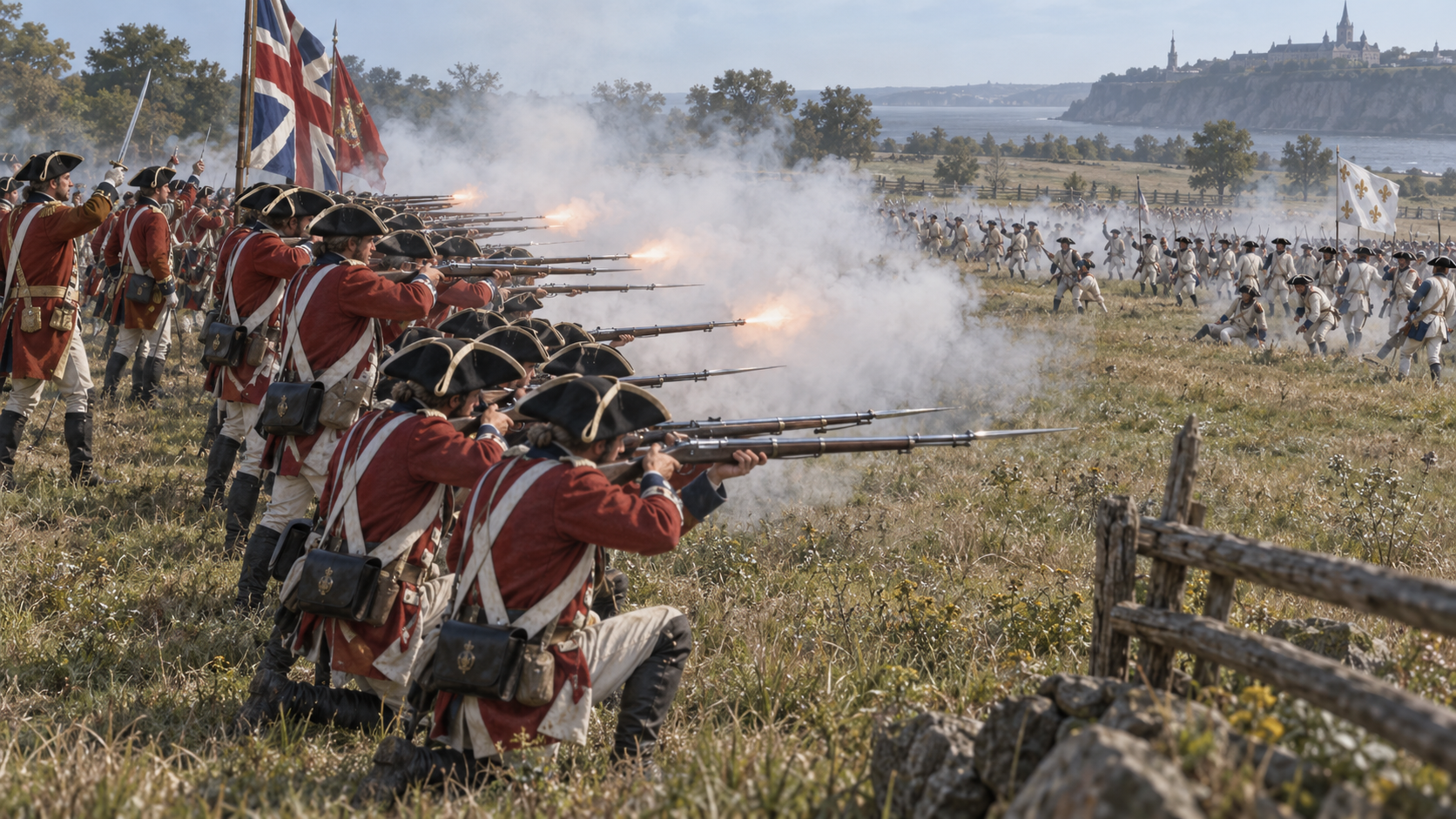


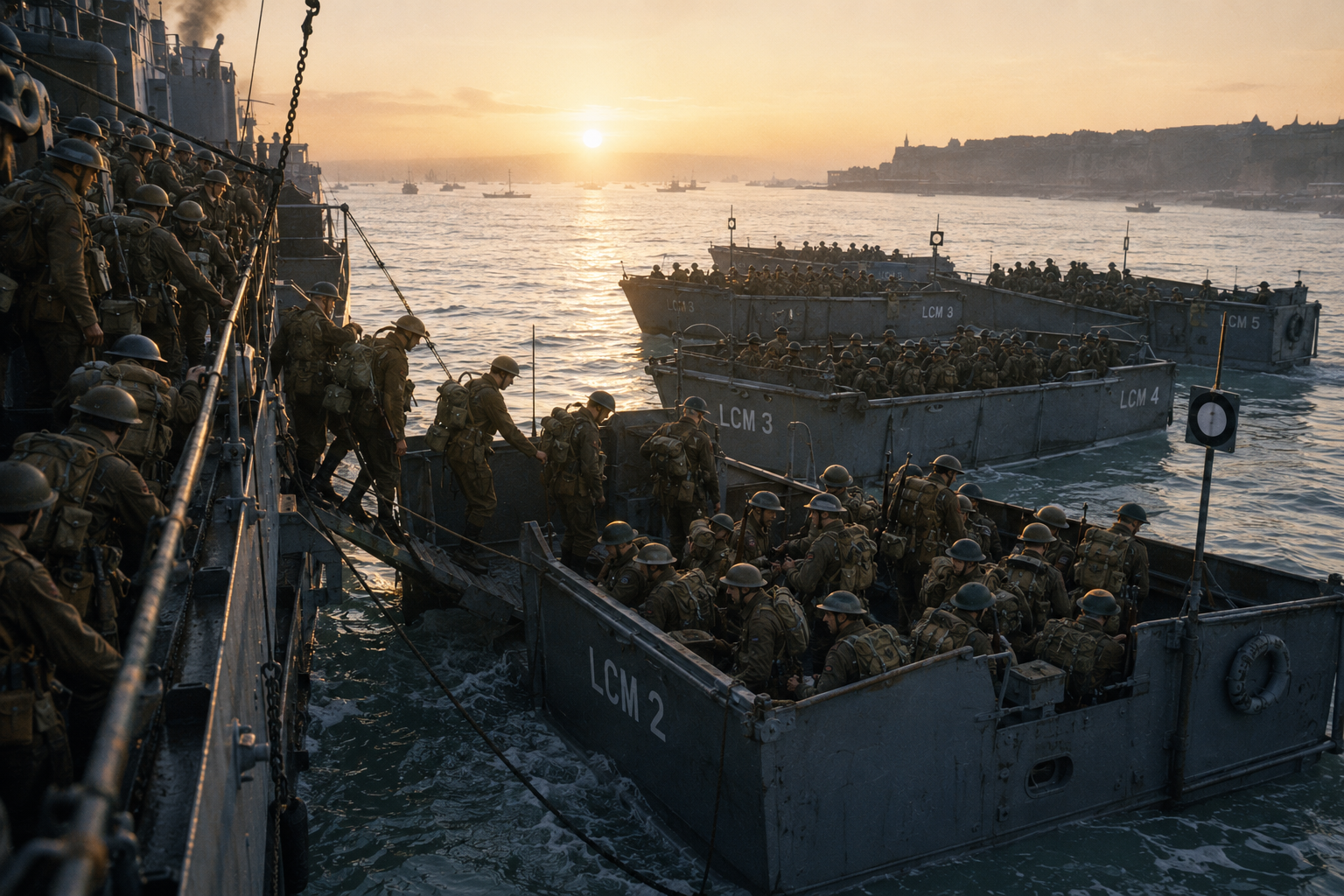
On the morning of August 19, 1942, thousands of Canadian soldiers approached the occupied coast of France in small landing craft. Ahead of them lay the port of Dieppe, its rocky beaches overlooked by cliffs, fortified buildings, artillery positions and German machine-gun posts. For many of these young Canadians, the grey outline of the French coast was their first sight of enemy-held Europe. Within hours, Dieppe would become one of the most tragic and costly chapters in Canadian military history.
In 2026, on the eighty-fourth anniversary of the raid, the Canada History Society has produced a commemorative video to ensure that the story of Dieppe—and particularly the Canadians who fought there—is not forgotten. The video remembers the men who landed on the beaches, those who supported them from the sea and air, and the families and communities across Canada that lived with the consequences of that terrible day.
The Dieppe Raid, code-named Operation Jubilee, was conceived as a large-scale assault against the German-occupied French coast. Its objectives included capturing and temporarily holding the port, gathering intelligence, destroying military installations, testing German defences and gaining practical experience in combined amphibious operations. The raid was also intended to demonstrate that the Western Allies were capable of striking continental Europe at a time when the Soviet Union was enduring immense pressure on the Eastern Front.
More than 6,000 Allied personnel took part, including 4,963 Canadians. British commandos and a small contingent of American Rangers joined the operation, while British and Canadian aircraft fought above the beaches and Royal Navy vessels supported the landings.
The Canadians came principally from the 2nd Canadian Infantry Division. Among the units committed were the Royal Regiment of Canada, the Essex Scottish Regiment, the Royal Hamilton Light Infantry, Les Fusiliers Mont-Royal, the South Saskatchewan Regiment, the Queen’s Own Cameron Highlanders of Canada, the Calgary Regiment and the 14th Canadian Army Tank Regiment. They represented communities from across the country. Many had spent years training in Britain and were eager to prove themselves in battle.
Before dawn, the assault force began moving towards five landing areas along approximately sixteen kilometres of coastline. Almost immediately, the carefully prepared plan began to unravel. Part of the force encountered a German coastal convoy, alerting the defenders. Several landings occurred late or without the intended support. At Puys, members of the Royal Regiment of Canada came ashore in daylight beneath steep cliffs and directly in front of prepared German positions. They were trapped against the seawall and subjected to devastating fire.
At Pourville, the South Saskatchewan Regiment and the Queen’s Own Cameron Highlanders initially made some progress, but the Canadians were unable to seize and hold their principal objectives. At Dieppe itself, the Essex Scottish and Royal Hamilton Light Infantry landed on an exposed stone beach under intense machine-gun, mortar and artillery fire. Calgary Regiment Churchill tanks came ashore to support them, but many became immobilized by the loose stones, damaged tracks, seawalls and obstacles along the waterfront.
British commandos achieved limited success on the flanks, most notably by destroying a German coastal artillery battery near Varengeville. These achievements, however, could not alter the outcome of the main assault. Communications deteriorated, commanders received incomplete information, and reinforcements were sent ashore without a clear understanding of the disaster unfolding on the beaches.
The order to withdraw was eventually given, but evacuation under enemy fire was extraordinarily difficult. Men waited in the water or sheltered behind wrecked tanks and landing craft as they hoped for rescue. Some were carried back to England. Others were killed, wounded or forced to surrender.
According to Veterans Affairs Canada, only 2,210 of the 4,963 Canadians who embarked for Dieppe returned to England, and many of those were wounded. Canada suffered 3,367 casualties, including 1,946 men taken prisoner. In total, 916 Canadians lost their lives as a result of the raid. Two Canadians—Honorary Captain John Weir Foote and Lieutenant-Colonel Charles Cecil Ingersoll Merritt—were awarded the Victoria Cross for their courage.
Behind every statistic was an individual life. The men at Dieppe were sons, husbands, fathers, brothers, friends and neighbours. Their losses were felt in Hamilton, Toronto, Montreal, Regina, Winnipeg, Calgary, Vancouver and in towns and villages throughout Canada. For some communities and regiments, Dieppe became a wound that never entirely healed.
The raid remains the subject of historical debate. Its planning, objectives and execution have been questioned for generations. Canadians should not diminish the failure of the operation or accept uncritically the comforting claim that every loss was justified by the lessons later applied in Normandy. Important lessons were learned about fire support, specialized landing craft, communications, intelligence, armoured engineering vehicles and the danger of attacking a heavily defended port directly. Those lessons influenced subsequent Allied amphibious operations. Nevertheless, the acquisition of useful knowledge does not erase the errors that placed so many soldiers in an almost impossible position.
To remember Dieppe honestly is therefore to hold two ideas together. It is necessary to examine the decisions that led to the catastrophe while also honouring the extraordinary courage of the men who were ordered to carry out the operation. Critical history and respectful remembrance are not opposites. Canadians owe the fallen both gratitude and truth.
The Canada History Society’s 2026 video seeks to bring this history to a new generation. Through historical photographs, maps, archival evidence and personal stories, it restores a human dimension to an event too often reduced to casualty figures or described merely as a rehearsal for D-Day. Dieppe was not a rehearsal for the Canadians who landed there. For them, it was a real battle fought against a determined enemy with live ammunition, terrible wounds and irreversible consequences.
As the Second World War passes beyond living memory, films of this kind become increasingly important. Canadians can no longer depend upon veterans visiting classrooms or standing before local cenotaphs to tell these stories themselves. The responsibility of remembrance now belongs to historians, educators, families, communities and institutions such as the Canada History Society.
Remembering Dieppe also provides an opportunity to reflect upon the meaning of service. The Canadians who approached those beaches did not know how the day would end. They went forward because they trusted their comrades, accepted their duty and believed that Nazi occupation had to be defeated. Their courage does not require us to pretend that the plan was flawless. It requires us to recognize what they endured after the plan failed.
On August 19, 2026, Canadians should pause to remember the men who landed at Dieppe eighty-four years earlier. We should remember those who fell on the beaches, those who died in captivity, those who endured years as prisoners of war and those who returned home carrying visible and invisible wounds. We should also remember the sailors and airmen who risked their lives above and offshore from the French coast.
The beaches of Dieppe are quiet today, but they remain part of Canada’s historical landscape. The sacrifice made there belongs not only to the families of the fallen or to the regiments that preserve their memory. It belongs to the country.
The Canada History Society’s video is an invitation to remember, to learn and to reflect. The men of Dieppe gave Canada their courage, their youth and, in hundreds of cases, their lives. The least succeeding generations can give them is the promise that their names, their service and their sacrifice will not be forgotten.
They were there. They endured. Canada remembers.