
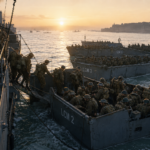


In the bleak and embattled landscapes of wartime Italy, the Canadian soldiers of the 1st Canadian Infantry Division and the 5th Canadian Armoured Division etched a story of courage, tenacity, and sacrifice that would leave an indelible mark on the nation’s history. Beginning with their arrival on Italian soil in September 1943, Canada’s involvement in the Italian Campaign was one of the most grueling and demanding chapters of World War II, but it was also a testament to the resolve and adaptability of the Canadian forces. For Canada, this campaign represented not only a test of military strength but also an opportunity to stand shoulder to shoulder with the world’s great powers and prove its mettle on the international stage.
Canada entered the Italian Campaign as part of a larger Allied strategy to weaken Germany by opening a southern front in Europe. The hope was to divert Axis forces from the Eastern and Western Fronts, making it more difficult for Germany to defend its occupied territories. Allied leaders, including British Prime Minister Winston Churchill and U.S. President Franklin Roosevelt, saw Italy as a “soft underbelly” of Europe, a vulnerable entry point through which to bring the war closer to German soil. For Canada, this campaign was about more than just strategy—it was an assertion of identity and capability. As historian Terry Copp aptly notes, “For Canadians, the Italian Campaign was an opportunity to step onto the world stage, proving their resilience and forging a national legacy in a theatre of war defined by brutal conditions and fierce resistance.”
Canada’s role in the Italian Campaign was extensive and multifaceted, involving thousands of soldiers, sailors, and airmen who would engage in some of the most challenging combat conditions of the war. Led by innovative commanders such as Major-General Guy Simonds and Lieutenant-General E.L.M. Burns, Canadian troops would face treacherous mountains, fortified enemy positions, and unforgiving weather as they fought their way from southern Italy toward Rome and beyond. The campaign saw Canadian forces involved in pivotal battles such as Ortona, where house-to-house fighting earned the brutal nickname “the Italian Stalingrad,” and Monte Cassino, a stronghold that symbolized the Axis’s tenacious grip on central Italy.
The campaign would exact a heavy toll on the Canadians, with thousands of casualties sustained over nearly two years of fighting. Yet, for the soldiers who survived and for the nation that followed their journey, the Italian Campaign became a defining moment. It was a crucible in which Canada’s military identity was forged, showcasing the discipline, resilience, and compassion that would become hallmarks of the Canadian forces in the years to come.
Planning and Preparation for the Invasion of Mainland Italy
After securing Sicily in the summer of 1943, the Allies turned their attention to the Italian mainland. The objective was clear: force Italy out of the Axis alliance and pressure Germany by opening a southern front. For the Canadians, this meant participating in Operation Baytown, the planned Allied landings at Reggio Calabria, followed by Operation Avalanche at Salerno. Planning for these operations was meticulous, with Canadian commanders coordinating closely with their British and American counterparts.
The Canadian 1st Infantry Division and the 5th Canadian Armoured Division underwent rigorous training in amphibious landings, urban warfare, and the unique challenges of mountain combat. Major-General Guy Simonds, an exceptional tactician known for his innovative approach, led the 1st Division. Historian C.P. Stacey remarked that Simonds’ leadership style was marked by “a relentless attention to detail,” a quality that would become critical as Canadian troops faced the unpredictable Italian terrain. Canadian soldiers spent weeks rehearsing landings and preparing for the logistical challenges of maintaining a steady supply line through rugged terrain and hostile territory.
Section Excerpt: The Battle of Ortona
The Battle of Ortona in December 1943 became one of the most famous and harrowing engagements for Canadian forces in the Italian Campaign. As the 1st Canadian Infantry Division advanced up the eastern coast of Italy, they encountered fierce resistance from entrenched German forces. Ortona, a small coastal town, was defended by elite German paratroopers who had fortified the area and were determined to hold their ground. Canadian forces, particularly the Loyal Edmonton Regiment and the Seaforth Highlanders, were tasked with capturing the town in a battle that quickly turned into grueling, close-quarters combat.
Described as “the Italian Stalingrad,” the battle involved intense house-to-house fighting, with Canadian soldiers clearing buildings room by room, often resorting to grenades and bayonets in the close confines. Mark Zuehlke captures the brutality of the battle: “Ortona was an unforgiving and claustrophobic hell. Canadian soldiers fought not just for victory but for survival, facing German troops who had transformed each building into a fortress.” After a week of relentless combat, Canadian forces managed to capture Ortona on December 28, 1943, in a victory that symbolized their tenacity and resolve.
Conclusion
Canada’s role in the Italian Campaign of World War II left an enduring legacy, showcasing the nation’s capacity for military leadership, strategic innovation, and remarkable resilience. Canadian forces faced some of the toughest fighting conditions in Europe, yet they proved themselves time and again, from the beaches of Reggio Calabria to the hilltops of Ortona and beyond. The Italian Campaign was a turning point, both in the war and in the story of Canada’s national identity. It proved that Canada was not merely a junior partner in the Allied cause but a capable and indispensable force in its own right.
As historian J.L. Granatstein reflects, “Canada’s role in Italy solidified its standing among the Allies, demonstrating that Canadian soldiers, sailors, and airmen could face and overcome the complexities of modern warfare.” The sacrifices made by Canada in Italy laid the groundwork for the nation’s post-war role on the world stage, and the memories of those who fought there remain an essential part of Canadian history. The Italian Campaign was more than just a battle for territory—it was a proving ground for Canada’s national spirit and an affirmation of the courage and dedication of its people.