


The Allied Decision to Invade Italy: The “Soft Underbelly of Europe”
After the successful Allied invasion of Sicily in July 1943, codenamed Operation Husky, the Allied leadership turned its attention to mainland Italy. Winston Churchill famously referred to Italy as the “soft underbelly of Europe,” seeing it as the most vulnerable Axis-held territory where the Allies could establish a foothold on the European continent. Italy’s geography and political instability suggested that the Axis might be more easily pried from this position than from northern Europe, which was heavily fortified. By invading Italy, the Allies aimed to weaken the Axis from within, force Italy to surrender, and compel Germany to divert significant resources away from the Eastern Front and France.
However, Churchill’s vision of a “soft underbelly” soon proved misleading, as the rugged terrain, mountainous defenses, and German fortifications turned the Italian Campaign into one of the most grueling and protracted fronts of the war. Historian Carlo D’Este, in his study of the Mediterranean Theater, observes that “the Italian Peninsula was anything but soft; it was, rather, a fortified bastion, with geography favoring the defenders at nearly every turn.” (Bitter Victory: The Battle for Sicily, 1943) Nevertheless, the invasion of Italy was strategically significant. By opening a new front, the Allies sought to disrupt Axis defenses, creating a pressure valve that would relieve the Soviet Union and weaken German fortifications in France, where an eventual invasion was already under discussion.
The decision to proceed with the invasion of Italy was finalized in a series of high-level meetings among Allied leaders, including the Casablanca Conference in January 1943, where Winston Churchill and Franklin D. Roosevelt met to plan the next phase of the European war. The Italian Campaign would offer the Allies a chance to capitalize on their recent success in North Africa and Sicily, pushing Axis forces out of the Mediterranean and weakening Italy, which had been suffering from war exhaustion and political dissent. Historian Rick Atkinson describes this strategic calculation, noting that “the Mediterranean was a corridor of opportunity for the Allies; controlling it could disrupt German supplies, boost Allied morale, and present a stepping stone toward Hitler’s fortress in Europe.” (The Day of Battle: The War in Sicily and Italy, 1943-1944)
Canada’s Role in the Allied Mediterranean Strategy and its Aspirations for Independence
For Canada, the Italian Campaign represented more than just a contribution to the Allied strategy; it was an opportunity to demonstrate the strength, resilience, and autonomy of its military on the world stage. Canadian forces had already gained combat experience in North Africa and Sicily, where their effective performance had earned respect among their British and American counterparts. The Canadian government and military leaders were determined to leverage this experience in Italy to further establish Canada as a capable and independent member of the Allied coalition.
Prime Minister William Lyon Mackenzie King recognized that Canada’s active and visible participation in Europe would shape the nation’s post-war status and influence. His support for Canadian involvement in the Italian Campaign was partly driven by a desire to solidify Canada’s international reputation. Historian Terry Copp explains, “Canada’s involvement in Italy was about proving itself not only as an effective fighting force but as a nation deserving of an independent voice in the post-war settlement. This campaign provided Canada with the opportunity to shape its legacy.” (Fields of Fire: The Canadians in Normandy)
In Italy, Canada was to play a central role in the British Eighth Army under General Bernard Montgomery, demonstrating that it could operate effectively within an international coalition while also making unique contributions. The Canadian Army was eager to test its 1st Infantry Division and the newly formed 5th Armoured Division, alongside Canadian air and naval units, in what promised to be a rigorous and demanding campaign. Canada’s participation in Italy would go beyond manpower; it represented a statement of Canadian resilience, innovation, and tactical prowess in overcoming the challenging Italian terrain and formidable German defenses.
Planning and Preparations for the Invasion of Mainland Italy
After the Allies secured Sicily, planning began immediately for the invasion of mainland Italy. The operation would involve two main landings: Operation Baytown, in which British and Canadian forces would cross the Strait of Messina from Sicily to Calabria, and Operation Avalanche, a larger amphibious assault at Salerno, designed to open a second front farther up the Italian coast. Canadian forces were deeply involved in the planning for Operation Baytown, as the 1st Canadian Infantry Division was assigned a leading role in establishing a foothold on the Italian mainland.
Logistics and Training for Amphibious Operations
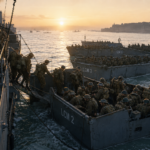
Preparing for the invasion required detailed logistical planning, particularly for amphibious landings. Canadian troops, who had gained experience with beach landings during the Sicilian Campaign, underwent additional training to prepare for the unique challenges posed by the narrow and mountainous coastal regions of Calabria. The 1st Canadian Infantry Division, under the command of Major-General Guy Simonds, had become adept at coordinating amphibious assaults and quickly advancing from beachheads. Historian C.P. Stacey describes the preparations, noting that “the Canadian forces approached their second Mediterranean landing with a confidence born of experience, but also with a sober understanding of the perils that awaited them on the Italian coast.” (Official History of the Canadian Army in the Second World War: The Italian Campaign)
Simonds was a meticulous and innovative commander, known for his ability to adapt strategies to difficult and unforeseen conditions. His training regimen emphasized speed, flexibility, and self-sufficiency, as the Canadians would likely encounter isolated pockets of German resistance in Calabria. In preparation for the assault, Canadian troops conducted night landings and practiced rapid deployment from landing craft, all while carrying full combat gear to maximize their readiness upon arrival.
Coordination with the British Eighth Army and Allied Forces
Canada’s role in the Italian Campaign required seamless coordination with other Allied units, particularly the British Eighth Army, under which the Canadians would serve. General Bernard Montgomery, who led the Eighth Army, worked closely with Major-General Simonds to integrate Canadian units into the broader operational strategy. The Eighth Army’s plan was to advance northward along the Adriatic coast, drawing German forces away from Salerno, where the U.S. Fifth Army would land. This dual-front approach was designed to overwhelm the German defenses and force them to split their resources.
The Eighth Army’s command structure emphasized collaboration, and Canadian forces were highly regarded for their professionalism and discipline. Canadian units developed close ties with British regiments, exchanging tactical insights and coordinating joint maneuvers. Historian Carlo D’Este notes that “the Canadians proved to be more than capable partners for the British; they brought a level of energy and resilience that helped drive the Eighth Army’s advance.” (Bitter Victory: The Battle for Sicily, 1943)
Royal Canadian Navy and Royal Canadian Air Force Preparations
The Royal Canadian Navy (RCN) and the Royal Canadian Air Force (RCAF) were integral to the success of the planned invasion. The RCN’s primary responsibilities included convoy escort across the Mediterranean, mine-clearing near the landing zones, and providing close support to amphibious landings. Ships such as HMCS Prince David were prepared to transport Canadian troops to the mainland, while destroyers and smaller vessels would offer fire support as needed.
The RCN also engaged in extensive anti-submarine operations to protect the convoys bringing Allied forces and supplies from North Africa and Sicily. The German and Italian submarines that patrolled the Mediterranean posed a constant threat, requiring Canadian and Allied ships to maintain high levels of vigilance. Canadian naval historian Marc Milner highlights the importance of these preparations: “The Royal Canadian Navy’s role in ensuring safe passage for Canadian and Allied troops was crucial to the initial success of the Italian Campaign. Without their diligent protection, the invasion force would have faced significant setbacks before even reaching the coast.” (Canada’s Navy: The First Century)
Meanwhile, the Royal Canadian Air Force (RCAF) prepared to provide air cover for the landings and conduct reconnaissance flights over enemy territory. Canadian squadrons, including No. 417 Squadron, flew dangerous reconnaissance and bombing missions to disrupt German supply lines and weaken coastal defenses. The RCAF’s strategic bombing of enemy positions in southern Italy helped to soften the defenses that Canadian and British forces would face upon landing. Historian Brereton Greenhous observed, “The work of Canadian pilots in securing air superiority over southern Italy was a vital factor in the Allies’ ability to move forward with confidence in the campaign.” (The Crucible of War: The Official History of the Royal Canadian Air Force)
The Role of Intelligence and Terrain Assessment
The planning for the Italian invasion required comprehensive intelligence gathering and terrain assessment, particularly as Italy’s geography posed a unique set of challenges. The rugged mountains, narrow roads, and fortified towns were ideal for defensive warfare, allowing the Germans to leverage natural barriers to their advantage. Allied intelligence, including the British Ultra program, provided valuable insights into German troop movements, fortifications, and supply routes, helping Allied planners map out potential obstacles.
Canadian engineers played an essential role in analyzing the terrain and developing strategies to overcome obstacles, including river crossings, minefields, and mountainous trails. They prepared for rapid deployment to build bridges, clear mines, and create routes for armoured units. The 5th Canadian Armoured Division, under the command of Major-General Bert Hoffmeister, was particularly attentive to these logistical preparations, as their tanks would be essential in breaking through German defensive lines. Historian Terry Copp noted that “the careful coordination of Canadian engineers, infantry, and armoured units became a hallmark of the Canadian approach in Italy, allowing them to advance methodically through some of the most challenging terrain in the war.” (The Brigade: The Fifth Canadian Infantry Brigade in World War II)