

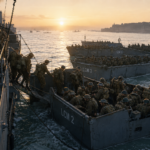


The Italian Campaign was a defining chapter in World War II, both strategically for the Allies and in terms of Canada’s military commitment and identity. This expanded section explores Canada’s dedication to the Allied cause, the strategic objectives behind the Italian Campaign, and the significant role that Canadian forces played in achieving these objectives. We’ll cover the importance of opening a southern front, the divisions and units involved, and the overarching goals of weakening Axis forces and diverting German resources.
Overview of Canada’s Commitment to the Allied Cause and the Significance of the Italian Campaign
Canada’s entry into the Second World War in 1939 was a statement of solidarity with the Allied forces and a reflection of the country’s determination to stand against the Axis powers. Canada’s commitment went far beyond symbolic gestures; by 1943, the Canadian government had mobilized significant numbers of troops, invested heavily in military infrastructure, and demonstrated a deep willingness to participate in major Allied operations. As historian Terry Copp noted, “Canada did not view itself as a passive supporter in the war effort. Instead, it was a committed partner, seeking every opportunity to contribute meaningfully to the Allied cause.” (Fields of Fire: The Canadians in Normandy)
The Italian Campaign, which began with the invasion of Sicily in July 1943, was a continuation of this dedication. After the success of Operation Husky in Sicily, Allied leaders saw an opportunity to push the Axis forces further back by invading mainland Italy. This campaign aligned perfectly with Canada’s desire to prove itself on the battlefield. By contributing a substantial force to the Italian Campaign, Canada aimed to affirm its role as an essential Allied power, capable of independent action while coordinating effectively with British and American forces.
Canadian Prime Minister William Lyon Mackenzie King recognized the importance of Canadian involvement, noting that “Canada’s presence in the Italian Campaign is not just a matter of military support; it is a statement of our values, our resilience, and our determination to fight for a free world.” Canada committed both its 1st Canadian Infantry Division and the 5th Canadian Armoured Division to the campaign, marking one of the largest deployments of Canadian forces in the war. This involvement underscored Canada’s commitment to the Allied cause and its determination to play a critical role in liberating Europe from Axis control.
Goals of the Italian Campaign: Weakening Axis Forces, Establishing a Southern Front, and Diverting German Resources
The Italian Campaign served as a strategic keystone in the Allies’ overall plan to liberate Europe. By 1943, the Allies recognized that a direct invasion of German-occupied France would be challenging without first drawing German forces away from the Western Front. The invasion of Italy, often referred to as the “soft underbelly” of Europe by British Prime Minister Winston Churchill, was seen as an effective way to undermine Axis forces by opening a new front. This strategy aimed to pressure the Axis on multiple fronts, stretching German military resources and compelling Hitler to commit forces to defend Italy.
Historian Carlo D’Este notes, “The Italian Campaign was more than just a stepping stone; it was a calculated move to fracture the Axis defense, complicate German logistics, and eventually create the conditions necessary for the liberation of Western Europe.” (Bitter Victory: The Battle for Sicily, 1943) The campaign’s objectives were multi-layered: weaken Italy’s alliance with Germany, diminish German strength through attritional battles in Italy’s difficult terrain, and secure key Mediterranean routes, facilitating Allied movement of troops and supplies.
Operation Baytown, the initial landing on mainland Italy in September 1943, and the subsequent Operation Avalanche at Salerno, were aimed at swiftly gaining a foothold and advancing northward. The campaign ultimately involved protracted, hard-fought battles through challenging mountainous regions, fortified Axis defenses, and strategically significant towns. For Canada, participation in the Italian Campaign was a chance to help achieve these broader goals, proving its mettle in grueling conditions while playing an indispensable role in the Allied advance.
The Canadian historian J.L. Granatstein emphasized the importance of Canada’s role in this complex and sustained operation, writing, “The Italian Campaign demanded every ounce of skill, adaptability, and courage from Canadian forces. It was here that Canadians would carve their place in the history of the Allied victory, not just as supporters but as pivotal participants in a grinding, unforgiving campaign.” (The Generals: The Canadian Army’s Senior Commanders in the Second World War)
Introduction to the 1st Canadian Infantry Division, 5th Canadian Armoured Division, and Supporting Naval and Air Force Units
The Canadian forces sent to Italy were among the best trained and most capable divisions within the Commonwealth forces. The 1st Canadian Infantry Division, known for its discipline and combat experience from the Sicilian Campaign, was commanded initially by Major-General Guy Simonds, a brilliant strategist with a reputation for rigorous attention to detail. Simonds was later replaced by Major-General Chris Vokes, another experienced leader, as the campaign advanced. The 1st Canadian Infantry Division’s combat-hardened units, such as the Loyal Edmonton Regiment, the Seaforth Highlanders, and the Princess Patricia’s Canadian Light Infantry, formed the backbone of Canada’s fighting force in Italy.
The 5th Canadian Armoured Division, led by Major-General Bert Hoffmeister, provided crucial armoured support that would prove invaluable in Italy’s mountainous and heavily fortified landscapes. Hoffmeister, a well-regarded leader known for his rapport with his troops, emphasized the need for adaptability and close coordination with infantry forces. His leadership allowed the 5th Armoured Division to provide mobile support in situations where conventional tank maneuvers were nearly impossible due to Italy’s difficult terrain. Historian Terry Copp observed that “Hoffmeister’s leadership transformed the 5th Armoured Division into a versatile, hard-hitting force capable of responding dynamically to the challenges of the Italian landscape.” (The Brigade: The Fifth Canadian Infantry Brigade in World War II)
In addition to the ground forces, the Royal Canadian Navy (RCN) and the Royal Canadian Air Force (RCAF) provided essential support throughout the Italian Campaign. The RCN’s role included convoy protection across the Mediterranean, mine-clearing operations, and bombardment support for amphibious landings. Ships like HMCS Prince David transported troops and equipment, while Canadian sailors often worked in hazardous conditions to secure safe passage through waters patrolled by German and Italian submarines.
The RCAF also played a critical role in the campaign, with Canadian pilots flying reconnaissance, providing air cover, and participating in strategic bombing missions. Units such as No. 417 Squadron, known as the “City of Windsor” Squadron, flew dangerous missions over enemy territory to disrupt Axis supply lines, weaken defenses, and support ground operations. Canadian airmen operated under challenging conditions, facing mountainous terrain, enemy anti-aircraft fire, and the threat of interception by the Luftwaffe. Historian Brereton Greenhous summarized the significance of the RCAF’s contributions, stating, “Canadian air squadrons provided the essential air superiority needed to keep Axis forces at bay, enabling Canadian and Allied ground forces to make steady, albeit hard-won, progress through the Italian front.” (The Crucible of War: The Official History of the Royal Canadian Air Force)
Together, the 1st Canadian Infantry Division, the 5th Canadian Armoured Division, the Royal Canadian Navy, and the Royal Canadian Air Force formed a robust, multi-branch force that contributed at every level of the Italian Campaign. These units were instrumental not only in combat but in the broader operational strategy that the Allies pursued in Italy.
The Strategic Importance of the Italian Campaign
The Italian Campaign held immense strategic importance for the Allies. By securing Italy, the Allies aimed to eliminate one of the Axis’s core members, Italy, from the war and force Germany into a defensive position in southern Europe. Italy’s mountainous terrain and numerous fortified positions offered the Germans natural defensive advantages, allowing them to delay and inflict heavy casualties on the advancing Allies. The campaign, therefore, represented a significant challenge that required sustained pressure and coordination across all Allied forces.
The Canadian commitment to the Italian Campaign served not only as a demonstration of loyalty to the Allied cause but also as a proving ground for Canada’s growing military ambitions. By committing significant ground, naval, and air resources, Canada demonstrated its ability to undertake extensive, independent operations within a broader Allied framework. The Canadian military was no longer merely a junior partner in British operations but a formidable force in its own right, operating alongside some of the largest and most experienced Allied units in the war.
According to Carlo D’Este, “The Italian Campaign was both a symbol and a practical manifestation of Allied unity. Each Allied nation brought its unique strengths to the battlefield, and Canada’s contribution proved invaluable.” (Bitter Victory: The Battle for Sicily, 1943) D’Este points out that the Canadian forces brought a specific set of skills and tenacity that helped the Allies break through well-defended lines like the Gustav Line and make incremental, though essential, progress toward Rome.
For Canada, the campaign also held symbolic importance. It represented the nation’s shift from being a colonial force supporting Britain to a capable and autonomous military power with the ability to operate on an international stage. Historian J.L. Granatstein captured this sentiment, writing, “The Italian Campaign cemented Canada’s role as a respected member of the Allied coalition, showcasing its military strength, resilience, and independence. Canada’s performance in Italy was a turning point in its journey toward post-war prominence.” (The Generals: The Canadian Army’s Senior Commanders in the Second World War)
In sum, the Italian Campaign allowed Canada to fulfill its commitment to the Allied cause, demonstrated Canada’s military proficiency and adaptability, and solidified its reputation as an independent and valuable partner in the global effort to defeat the Axis powers. The contributions of the 1st Canadian Infantry Division, 5th Canadian Armoured Division, and supporting naval and air force units in Italy reflected Canada’s dedication to the mission and left an enduring legacy of bravery, resilience, and sacrifice.