
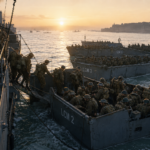


The Italian Campaign: Canada’s Journey from Messina to Victory
The Italian Campaign, stretching from July 1943 to April 1945, was a two-year ordeal that took Canadian forces through mountainous terrain, fortified towns, and riverside defenses, fighting against some of the best-prepared troops in the German Wehrmacht. For the 1st Canadian Infantry Division and the 5th Canadian Armoured Division, as well as other supporting Canadian units, the campaign would be one of steady attrition, a relentless push up the boot of Italy that tested both endurance and tactical skill. Historian C.P. Stacey wrote, “The Italian Campaign was a road of sacrifice, a journey from one battlefield to the next, where each hill, valley, and river became a place of valor and suffering” (Six Years of War).
Canada’s entry into the Italian campaign began with the Allied invasion of Sicily, followed by the crossing to mainland Italy and a relentless series of battles, from the Moro River and Ortona to the Gothic Line and finally into the Po Valley. Each step of the campaign revealed the challenges of the Italian landscape, the ferocity of German defenses, and the unbreakable determination of Canadian soldiers.
Crossing at Messina: The Invasion of Italy Begins
The Italian Campaign began with the invasion of Sicily in July 1943, a crucial precursor to the assault on mainland Italy. The Allies, under General Dwight D. Eisenhower, launched the invasion of Sicily to eliminate Axis forces on the island and secure control of the Mediterranean, hoping that a swift victory would open the way to Italy itself. The 1st Canadian Infantry Division, under Major-General Guy Simonds, was part of General Bernard Montgomery’s British Eighth Army.
The Canadians fought through Sicily’s rugged hills, facing German and Italian troops in intense skirmishes around towns like Leonforte and Agira. The capture of Sicily was completed in August 1943, leading to the Allied crossing of the Strait of Messina into mainland Italy. The Canadian forces then prepared for a daunting task: the slow, grinding advance up the Italian peninsula.
Landing at Reggio Calabria and the Push Northward
The Canadian 1st Infantry Division landed at Reggio Calabria in September 1943, marking the first Allied foothold on the Italian mainland. The initial stages of the campaign saw Canadian troops advancing relatively quickly through Calabria and Campania, pushing up toward the more heavily fortified central regions of Italy. By October, the Canadians were advancing through mountainous terrain and facing the first of many German defensive lines.
As they moved northward, Canadian forces became increasingly familiar with the tactics and tenacity of Field Marshal Albert Kesselring, commander of German forces in Italy. The Germans used Italy’s natural landscape to their advantage, setting up fortified lines across rivers, mountains, and narrow passes. Historian Tim Cook observed, “Italy’s terrain was as much an enemy as the German troops themselves, each natural barrier transformed into a defensive wall that required ingenuity and sacrifice to breach” (The Necessary War).
The Moro River and Ortona: Canada’s Test of Endurance
In December 1943, the Canadians reached the Moro River, one of the most difficult battles in the Italian campaign and a prelude to the equally fierce Battle of Ortona. The 1st Canadian Infantry Division, led by Major-General Chris Vokes, was tasked with crossing the Moro River and capturing Ortona, a coastal town vital to the Allied advance.
The Battle of the Moro River saw Canadian troops engage in grueling, close-quarters combat, as they fought across olive groves, vineyards, and muddy riverbanks. The German forces, entrenched and well-prepared, forced the Canadians to adapt to new tactics, including “mouse-holing,” which involved blasting through walls to avoid the deadly open streets. After weeks of bloody fighting, Canadian forces successfully crossed the Moro and advanced into Ortona, but the cost was high, with hundreds of casualties. Historian C.P. Stacey described Ortona as “a furnace of battle, where courage was measured in steps taken and ground held under the fiercest resistance” (Six Years of War).
The capture of Ortona, though hard-won, signified the Canadians’ resilience and ability to endure some of the toughest conditions of the Italian campaign. By January 1944, Canadian forces had cleared the town, but they still faced the daunting task of pushing through the German defenses that lay further north.
The Liri Valley and the Breakthrough at the Hitler Line
As the spring of 1944 arrived, the Canadian 1st Division and the newly arrived 5th Canadian Armoured Division prepared to breach the Hitler Line, another segment of German defenses established along the Liri Valley. By this time, the Italian campaign had turned into a series of assaults on fortified lines, with each victory opening the way to yet another formidable barrier.
The Canadian assault on the Hitler Line in May 1944 was a coordinated effort, involving both infantry and armor. The 5th Canadian Armoured Division, led by Major-General Bert Hoffmeister, provided crucial support, using tanks to breach the heavily fortified line. The combined efforts of Canadian artillery, infantry, and armor finally overcame the German positions, forcing Kesselring’s forces to retreat further north. Historian J.L. Granatstein noted, “The Hitler Line, like so many barriers before it, fell to the Canadians through a combination of brute force and relentless determination” (Canada’s War).
The success in the Liri Valley enabled the Allies to capture Rome in June 1944, marking a major turning point in the Italian campaign. Yet, for Canadian forces, the campaign was far from over. Even with Rome secured, the Germans regrouped and prepared to defend the next line of fortifications in northern Italy.
The Gothic Line: Canada’s Role in Breaking the Final German Barrier
By August 1944, Canadian forces reached the Gothic Line, the last and most formidable of Germany’s defensive lines in Italy. Set among the Apennine Mountains, the Gothic Line was fortified with bunkers, minefields, and artillery positions, designed to slow the Allied advance into the Po Valley. The 1st Canadian Corps, now led by Lieutenant-General E.L.M. Burns, was assigned to breach this line.
The Canadians faced intense resistance as they fought through the Gothic Line. Units like the Seaforth Highlanders of Canada and the Royal Canadian Regiment bore the brunt of the fighting, advancing slowly through rough, mountainous terrain. Artillery and tank support were crucial, but the terrain often made maneuvering difficult, forcing Canadian troops into close-quarters combat with well-prepared German defenders.
The fighting was fierce, but by mid-September, Canadian forces had succeeded in breaking through the Gothic Line, pushing the Germans back and opening the way to the Po Valley. Historian Tim Cook wrote, “The Gothic Line was a final testament to the Canadians’ tenacity, a battle fought on ground that seemed as unforgiving as the enemy who held it” (The Necessary War).
The Final Push: The Po Valley and the End of the Italian Campaign
The breakthrough at the Gothic Line marked the beginning of the end for German forces in Italy. In the spring of 1945, Canadian units, alongside other Allied forces, launched a final offensive across the Po Valley, advancing rapidly against a weakened and retreating enemy. The fertile plains of the Po Valley provided open ground for Canadian armor to operate effectively, allowing a faster pace than the mountainous regions that had dominated much of the campaign.
By April 1945, Canadian forces had crossed the Po River and were advancing toward the Alps. German resistance, while determined, was beginning to collapse. The campaign in Italy officially came to an end on May 2, 1945, when German forces in Italy surrendered, marking the conclusion of nearly two years of Canadian involvement in the Italian theater.
Outcome and Casualties: A Costly Victory
The Italian Campaign was one of the most grueling experiences for Canadian forces in World War II. Over the course of the campaign, Canada suffered approximately 26,000 casualties, including over 5,900 killed. Each battle, from the Moro River and Ortona to the Gothic Line, exacted a heavy toll, testing the endurance and courage of Canadian soldiers.
For the men of the 1st Canadian Infantry Division and 5th Canadian Armoured Division, the campaign left a lasting legacy of sacrifice. Historian C.P. Stacey observed, “Italy was a crucible of war for Canada, a place where the nation’s soldiers forged a reputation for resilience in the face of daunting obstacles” (Six Years of War).
Strategic and Tactical Significance of the Italian Campaign
The Canadian role in the Italian Campaign was vital to the Allied effort in Europe. While the Italian front did not receive the same attention as the Western Front, the campaign drew German resources and troops away from other areas, weakening the Axis’s overall defensive posture. The Canadians’ ability to overcome some of the most heavily fortified positions in Italy demonstrated their skill and determination.
Tactically, the Italian campaign required Canadian forces to adapt to new methods of warfare, from mountain fighting to urban combat. The tactics and experience gained in Italy would prove invaluable in subsequent campaigns, influencing Canadian military doctrine and shaping the capabilities of the post-war Canadian military.
Conclusion: The Legacy of the Italian Campaign
The Italian Campaign remains one of the most defining and costly chapters in Canadian military history. For Canadian soldiers, the journey from Messina to the Po Valley was a path marked by hardship, resilience, and sacrifice. Today, the legacy of the Italian Campaign endures, commemorated in the memory of those who fought and in the history of a nation that stood firm amid the crucible of war.
Historian Tim Cook captured the essence of the campaign, writing, “Italy was Canada’s long road of struggle and triumph, a place where soldiers carved their names into the stones of history with valor and blood” (The Necessary War). The Canadian contribution to the Italian Campaign stands as a testament to the nation’s role in the Allied victory and the enduring courage of its soldiers.
References
- Stacey, C.P. Six Years of War: The Army in Canada, Britain, and the Pacific. Queen’s Printer, 1955.
- Granatstein, J.L. Canada’s War: The Politics of the Mackenzie King Government, 1939–1945. University of Toronto Press, 1975.
- Cook, Tim. The Necessary War: Canadians Fighting the Second World War, 1939–1945. Penguin Canada, 2014