


The Seven Years’ War: The First Global War
The Seven Years’ War (1756–1763) was a truly global conflict that altered the course of history, stretching from the plains of North America to the far reaches of India and the Caribbean. Often described as the first “world war,” it was a culmination of decades of rivalry between Britain and France. While the war’s initial spark was lit in the forests of North America, its flames soon spread across the Atlantic, engulfing Europe and beyond. Britain’s ultimate triumph owed much to William Pitt’s strategic vision, which brought sweeping victories and reshaped the colonial world.
Political Situation at the Outset
In the mid-18th century, North America was a contested frontier. France controlled vast swathes of territory, including Canada, Louisiana, and lands west of the Appalachian Mountains, while Britain’s colonies hugged the Atlantic seaboard. The French strategy relied heavily on a network of forts along major waterways, particularly the Mississippi River and the Great Lakes, which served as arteries for trade and military movement. Indigenous nations played a pivotal role in this balance of power, forging alliances that could tip the scales in favour of either side.
The British colonies, by contrast, were economically robust and rapidly expanding. However, the Appalachian Mountains represented both a physical and geopolitical barrier, frustrating colonial ambitions. The British government, meanwhile, was more focused on European conflicts and was reluctant to support colonial expansion.
Historian Fred Anderson describes the tension succinctly: “North America in the 1750s was a powder keg, with imperial ambitions, settler encroachments, and Indigenous resistance forming an explosive mix.”
Causes of the Outbreak of Hostilities
The immediate cause of the conflict was competition for control over the Ohio River Valley, a fertile region vital for both settlement and trade. French forces constructed a series of forts to assert their claim, culminating in Fort Duquesne (modern Pittsburgh). In response, British colonial leaders, particularly those from Virginia, launched military expeditions to challenge French dominance.
The spark came in 1754, when a young George Washington led a force of Virginia militia into the Ohio Valley. Washington’s men clashed with a French detachment near Fort Duquesne, capturing and killing the French commander, Joseph Coulon de Jumonville. This incident, known as the Battle of Jumonville Glen, escalated into open war.
William R. Nester observes, “The Ohio River Valley was the epicentre of the struggle, but its significance extended far beyond; it symbolized the broader contest for North America.”
Military Aspects and Battles
The Early Conflicts in North America (1754–1756)
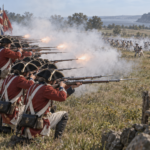
The initial phase of the war was marked by British setbacks. In 1755, Major General Edward Braddock’s expedition to capture Fort Duquesne ended in disaster. Ambushed by a combined force of French soldiers and Indigenous allies, Braddock was mortally wounded, and his army was routed. The battle underscored the effectiveness of Indigenous guerrilla tactics in the dense forests of North America.
Meanwhile, French forces under the command of Louis-Joseph de Montcalm achieved significant victories. The capture of Fort Oswego in 1756 and Fort William Henry in 1757 showcased French military superiority in the early stages of the war.
The Global Spread of the War (1756–1761)
By 1756, the conflict had spread to Europe, where it became part of the broader Seven Years’ War. Britain’s alliance with Prussia and Hanover clashed with France’s coalition, which included Austria, Russia, and Spain. In India, the British East India Company fought French forces for control of trade and territory, while in the Caribbean, the two powers vied for lucrative sugar islands.
Pitt’s Strategic Vision
The turning point came with the rise of William Pitt the Elder as Britain’s de facto war leader. Recognizing the global nature of the conflict, Pitt directed Britain’s resources toward defeating France on multiple fronts. He prioritized North America, believing that the colonies represented the future of British power.
Pitt’s strategy included:
- Strengthening the Royal Navy to dominate the seas.
- Supporting Prussia as a bulwark against France in Europe.
- Funding colonial militias and deploying British regulars to North America.
Fred Anderson notes, “Pitt’s genius lay in his ability to integrate global strategy with local resources, transforming Britain’s war effort from reactive defence to aggressive offence.”
The Fall of New France (1758–1760)
The most spectacular victories of the war occurred in North America. In 1758, British forces captured Louisbourg, the key French fortress on Cape Breton Island, opening the way to the St. Lawrence River. The same year, British and colonial forces took Fort Frontenac, cutting French supply lines.
The decisive blow came in 1759 with the Battle of the Plains of Abraham outside Quebec City. British General James Wolfe led an audacious assault on the French under Montcalm. Both commanders were killed, but the British emerged victorious, capturing Quebec. In 1760, the British took Montreal, effectively ending French rule in Canada.
Results of the Battles
The fall of New France was a transformative moment in North American history. The British gained control of Canada, securing dominance over the continent. French ambitions in North America were shattered, reduced to a foothold in Louisiana and scattered territories.
The broader war also saw British victories in the Caribbean, West Africa, and India. By the time the Treaty of Paris was signed in 1763, Britain had emerged as the world’s pre-eminent colonial power.
Resultant Outcome of the Conflict
The Seven Years’ War profoundly reshaped the world. For Britain, the war was a triumph, but the cost of maintaining its expanded empire would soon become apparent. The war’s massive debt burden led to increased taxation in the colonies, sowing the seeds of the American Revolution.
For France, the loss of its North American territories was a humbling defeat, but the experience galvanized reforms that would later fuel its resurgence in the Napoleonic Wars.
Indigenous nations suffered immensely, as the removal of French influence left them vulnerable to British expansion. Historian Colin Calloway laments, “The Seven Years’ War marked the beginning of a catastrophic era for Indigenous peoples, as British policies prioritised settler expansion over diplomacy.”
Military Units and Commanders
- British Forces:
- Key Commanders: General James Wolfe, General Jeffrey Amherst, Admiral Edward Boscawen
- Composition: Regular British troops, colonial militias, and allied Indigenous forces
- French Forces:
- Key Commanders: Louis-Joseph de Montcalm, François-Gaston de Lévis
- Composition: French regulars, Canadian militia, and allied Indigenous warriors
The British forces’ professionalism and Pitt’s strategic investments eventually outmatched the resource-strained French.
Conclusion
The Seven Years’ War was not merely a military conflict but a transformative event that reshaped the global order. From the forests of North America to the plains of India, its impact was profound and far-reaching. The fall of New France, achieved through Pitt’s visionary strategy and the sacrifice of countless soldiers, marked the ascendancy of British power and the dawn of a new age in global history.
Fred Anderson encapsulates the war’s significance: “The Seven Years’ War was not just a struggle for empire; it was a struggle for the future of modernity, with the winners setting the terms for centuries to come.”
References
- Anderson, Fred. Crucible of War: The Seven Years’ War and the Fate of Empire in British North America, 1754-1766. New York: Vintage Books, 2000.
- Nester, William R. The Epic Contest: The Struggle for North America, 1754–1763. Santa Barbara: Praeger, 2000.
- Calloway, Colin G. The Scratch of a Pen: 1763 and the Transformation of North America. Oxford: Oxford University Press, 2006.
- Steele, Ian K. Warpaths: Invasions of North America. New York: Oxford University Press, 1994.